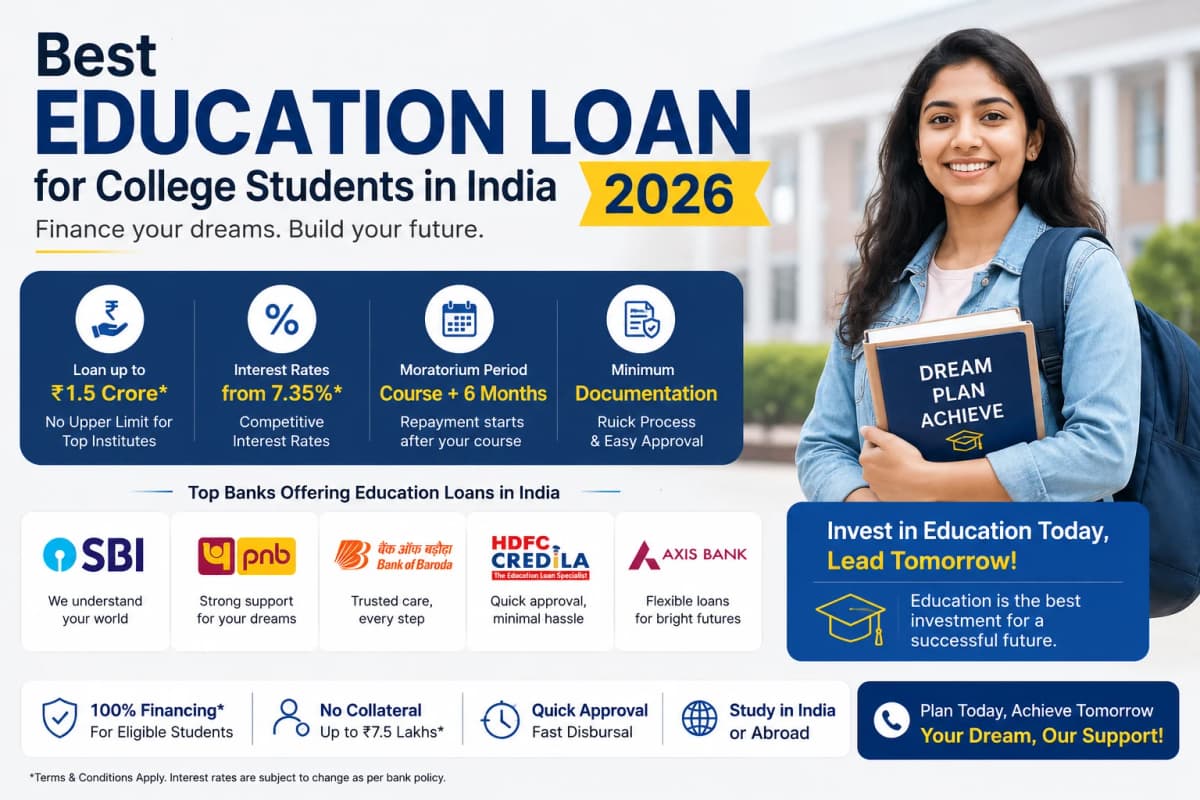
What is the maximum amount for an education loan for college students in India?
Most Indian banks offer up to 7.5 Lakhs without any collateral. For higher amounts, students can get up to 1.5 Crores for domestic studies and even more for overseas education, depending on the course, the institution’s reputation, and the value of the security provided.
What are the interest rates for student loans in India in 2026?
Currently, interest rates for an education loan for college students in India typically range from 8.5% to 12.5% per annum. Government banks usually offer lower rates, while private lenders and NBFCs may charge more but offer faster processing and flexible terms for non-premier colleges.
Can I get a loan for college in India without collateral?
Yes, under the Model Education Loan Scheme, students can secure up to 7.5 Lakhs without providing any collateral or third-party guarantee. For students getting into premier institutes like IITs or IIMs, many banks extend this limit up to 40 Lakhs or 50 Lakhs without security.
Understanding the Education Loan Landscape in India
An education loan for college students in India is more than just a debt; it is an investment in future earning potential. In India, these loans cover more than just tuition.
Most banks cover "total cost of study," which includes hostel fees, books, laptops, and even travel expenses for those studying abroad. This holistic approach ensures students can focus entirely on their academics.
Why Opt for a Student Loan?
Relying on personal savings can deplete a family's safety net. Loans offer tax benefits under Section 80E of the Income Tax Act, allowing parents or students to deduct the interest paid from their taxable income.
Types of Education Loans Available
1. Loans for Domestic Studies
These are specifically for students pursuing degrees within India. Banks have "Prime" lists of colleges where they offer better rates and higher loan amounts due to the high employability of graduates.
2. Loans for Studies Abroad
If you are heading to the US, UK, or Canada, these loans cover high tuition costs and living expenses. They often require collateral if the amount exceeds a certain threshold.
3. Collateral vs. Non-Collateral Loans
Non-Collateral: No property or assets are required. These are based on the student's academic record and the co-applicant's income.
Collateral-based: Required for very high loan amounts. You can pledge a house, land, or fixed deposits as security.
Key Features of Education Loans in India
The Moratorium Period
One of the best features of an education loan for college students in India is the "holiday period." You aren't required to start repaying the principal while you are still studying.
Usually, the moratorium lasts for the duration of the course plus 6 to 12 months. This gives the student enough time to find a job before the EMIs begin.
Loan Margin
For loans up to 4 Lakhs, there is usually no margin, meaning the bank pays 100% of the costs. For higher amounts, the margin is typically 5% for studies in India and 15% for studies abroad.
Repayment Tenure
Modern student loans offer flexible repayment periods. You can choose to pay back the loan over 10 to 15 years, making the monthly installments manageable.
Top Banks Offering Education Loan for College Students in India
Bank/Lender | Approx. Interest Rate | Max Loan Amount (Domestic) |
State Bank of India (SBI) | 8.55% - 11.15% | Up to 1.5 Crores |
HDFC Bank | 9.50% - 13.00% | Based on requirement |
ICICI Bank | 9.25% - 12.50% | Up to 1 Crore |
Bank of Baroda | 8.85% - 11.50% | Up to 80 Lakhs |
Punjab National Bank | 8.75% - 10.50% | Need-based |
Eligibility Criteria for Students
To qualify for an education loan for college students in India, you must meet specific standards set by the Reserve Bank of India (RBI) and the individual bank.
Nationality: You must be an Indian citizen.
Admission: You must have a confirmed seat in a recognized college or university.
Course Type: The course must be a professional or technical degree/diploma.
Co-Applicant: Since students have no income, a parent or guardian must sign as a co-borrower.
Documents Required for the Application
Having your paperwork ready can speed up the process by weeks. Here is what you generally need:
For the Student:
Letter of admission from the college.
Mark sheets of 10th, 12th, and Graduation (if applicable).
Entrance exam results (JEE, NEET, CAT, GRE, etc.).
Schedule of expenses provided by the college.
For the Co-Applicant (Parent/Guardian):
KYC documents (Aadhar Card, PAN Card).
Proof of income (Salary slips or ITR for the last 2 years).
Bank statements for the last 6 months.
How to Apply for an Education Loan via Vidya Lakshmi Portal
The Government of India launched the Vidya Lakshmi Portal to simplify the process. It is a single platform where students can view and apply for loans from multiple banks.
Register: Create an account on the Vidya Lakshmi website.
Fill the CELAF: Complete the Common Education Loan Application Form.
Search & Apply: Look for banks that fit your criteria and apply to them directly through the portal.
Track: You can track the status of your application in real-time.
Subsidies and Government Schemes
The Indian government provides several interest subsidy schemes to help students from economically weaker sections (EWS).
CSIS (Central Sector Interest Subsidy)
This scheme is for students with a parental income of up to 4.5 Lakhs per year. The government pays the interest on the loan during the moratorium period, significantly reducing the total debt.
Padho Pardesh & Dr. Ambedkar Scheme
These are specifically designed for students from minority communities or OBC categories who wish to study abroad. They provide interest subsidies during the study period.
Tips to Get Your Loan Approved Quickly
Maintain a Good Credit Score: The bank will check the co-applicant’s CIBIL score. A score above 750 is ideal.
Choose a Recognized Institute: Banks are much faster at approving loans for "Grade A" or NAAC-accredited colleges.
Be Honest: Never hide existing debts or provide fake documents. It will lead to immediate rejection.
Early Application: Start your loan process as soon as you get your entrance results, don't wait for the last date of admission.
Conclusion
Securing an education loan for college students in India is a structured process designed to help you reach your academic goals. By comparing interest rates, understanding the moratorium period, and utilizing government portals like Vidya Lakshmi, you can fund your education without undue stress. Always read the fine print regarding processing fees and prepayment penalties to ensure you are getting the most honest deal possible.
Frequently Asked Questions (FAQs)
1. Can I get an education loan if I have a gap year?
Yes, most banks accept a gap year as long as you can explain it. Whether you were preparing for entrance exams or had personal reasons, a gap year does not automatically disqualify you from getting a loan.
2. What happens if I cannot find a job immediately after college?
If you face difficulty finding a job, you can approach your bank to extend the moratorium period. While not guaranteed, many banks offer a "grace period" or can restructure the loan if you show genuine financial hardship.
3. Is a PAN card mandatory for an education loan?
Yes, a PAN card is mandatory for both the student and the co-applicant. If you do not have one yet, you should apply for it immediately as it is a primary document for financial verification.
4. Does the loan cover the cost of a laptop?
Yes, most education loans for college students in India cover the purchase of a laptop or any other equipment necessary for the completion of the course, provided it is mentioned in the college’s expense estimate.
5. Can I repay my loan early?
Absolutely. Most floating-rate education loans in India do not have prepayment penalties. Paying off your loan early can save you a significant amount of money in interest.
6. Is there a female student discount on interest rates?
Yes, many Indian banks like SBI and PNB offer a 0.50% concession on interest rates for female students to encourage higher education among women.