20 Lakh Home Loan Balance Transfer Benefits: A Beginner's Guide
Managing a long-term debt like a housing loan requires continuous monitoring of financial market trends. Many first-time home buyers assume that once they sign a loan agreement with a bank, they are locked into those exact terms for decades.
However, if you notice that other reputed banks are offering significantly lower interest rates than your parent lender, you do not have to stay stuck. You can shift your remaining debt to a new lender using a financial facility called a home loan balance transfer.
This beginner-friendly guide walks through the core 20 lakh home loan balance transfer benefits. We will examine how shifting your loan can drastically lower your monthly financial pressure and save you substantial cash over time.
Direct Answer Snippets for Quick Reference
What are the main benefits of a 20 lakh home loan balance transfer?
The primary 20 lakh home loan balance transfer benefits include securing a lower market interest rate, which automatically reduces your monthly EMI outgo. Additionally, it allows you to renegotiate your remaining repayment tenure and unlocks eligibility for high-value, low-cost top-up loans for home renovations.
How much money can I save by transferring a 20 lakh home loan?
If you transfer a 20 lakh home loan with 15 years remaining from a high interest rate of 9.5% down to a competitive rate of 7.5%, your monthly EMI drops from roughly 20,885 to 18,540. This tiny shift saves you over 4.2 lakhs in total lifetime interest.
When is the best time to execute a home loan balance transfer?
The most profitable time to execute a home loan balance transfer is during the initial 3 to 7 years of your overall loan lifecycle. This is because your regular monthly installments consist mostly of front-loaded interest payments during the early years, maximizing your long-term compounding savings.
What Exactly is a Home Loan Balance Transfer?
A home loan balance transfer, often referred to as home loan refinancing, is a clean legal process where a new bank takes over your existing debt. Think of it as a professional swap between financial institutions.
When you apply for a transfer, the new bank reviews your current financial profile and property records. Once approved, the new bank directly pays off the total outstanding principal balance to your old bank to shut down that specific loan account.
Moving forward, your old debt is completely wiped clear, and you start paying fresh, lower monthly installments to your new lender under revised, friendlier terms.
1. Massive Savings from a Lower Interest Rate
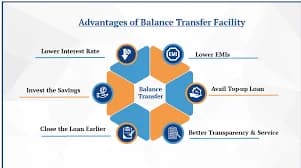
The absolute king among all 20 lakh home loan balance transfer benefits is the immediate reduction in your prevailing interest rate percentage. Even a minor gap of 0.50% to 1.00% can alter your long-term wealth accumulation.
When the Reserve Bank of India adjusts economic benchmarks, some banks pass on the rate cuts to everyday consumers much faster than others. If your current lender keeps your rates high, transferring out forces market competition to work in your favor.
Let us evaluate how a rate reduction changes your financial outgo on a 20 lakh outstanding balance over a remaining tenure of 20 years.
Comparison of Total Loan Costs Across Decreasing Interest Rates
Effective Interest Rate | Monthly EMI Outgo | Total Lifetime Interest | Total Amount Repaid |
9.50% (Old High Rate) | 18,643 | 24,74,319 | 44,74,319 |
8.50% (Medium Rate) | 17,356 | 21,65,541 | 41,65,541 |
7.50% (New Lowest Rate) | 16,112 | 18,66,862 | 38,66,862 |
By executing a strategic transfer to drop your rate from 9.50% to 7.50%, you instantly slash your monthly household liability by more than 2,500. More importantly, you erase over 6 lakh of waste interest payments from your life.
2. Flexibly Reshaping Your Repayment Tenure
Every individual's corporate career and cash flow situation evolve over time. Shifting your housing loan folder to a new bank gives you a rare opportunity to entirely restructure your remaining repayment timeline.
Depending on your current household goals, you can steer your tenure in two distinct directions:
Opting for a Shorter Tenure
If your monthly salary has increased through promotions, you can choose to keep your monthly installment amount identical to what you were paying before. By combining this with a lower interest rate, you will accelerate your principal clearance and step into a debt-free life years ahead of schedule.
Extending Your Repayment Window
If your household is facing temporary financial tightness due to children's education or medical bills, you can request the new lender to stretch your repayment window up to a fresh 25 or 30-year limit. This action successfully drops your regular monthly EMI down to a highly manageable, stress-free baseline.
3. Unlocking the Power of a High-Value Top-Up Loan
Another highly practical feature included in the list of 20 lakh home loan balance transfer benefits is instant access to a secondary pool of capital called a top-up loan.
When you transfer your main housing loan, the new bank evaluates how much your underlying property value has climbed over the years. If your home value has expanded, lenders will happily grant you an additional parallel loan line over and above your 20 lakh balance.
The massive advantage here is that top-up home loans operate at interest rates that are significantly cheaper than standard personal loans or credit card credit lines. You can legally use this extra low-cost money to renovate your kitchen, fund higher education, or clear off high-interest personal debts.
Core Administrative Expenses to Calculate Before Switching
While the mathematical interest savings look incredibly lucrative on paper, a home loan transfer is not entirely free. You must honestly account for the small administrative costs involved in moving banks.
To ensure your switch makes perfect financial sense, analyze these typical out-of-pocket charges:
New Processing Fees: The incoming bank will charge a one-time fee to process your file, ranging from a flat 3,000 to 0.50% of your loan size.
Legal and Technical Valuation Fees: External lawyers and asset appraisers charge small fees to verify that your home papers are clean and legally fit for a new mortgage.
Old Bank Foreclosure Charges: According to central banking guidelines, old lenders cannot charge exit penalties on floating-rate individual home loans. However, if you are currently on a rare fixed-rate structure, a minor exit fee might apply.
Conclusion
Maximizing the 20 lakh home loan balance transfer benefits is an excellent way for proactive borrowers to optimize their long-term home costs. Shifting your loan file unlocks lower interest rates, drops your monthly EMI burden, and provides cheap top-up funds to fuel your family's future dreams.
Always ensure that the total financial savings generated by the lower interest rate comfortably outweigh the upfront processing fees charged by the new bank. With calculated planning and a healthy credit score, a balance transfer will smoothly elevate your financial freedom and protect your household budget for years to come.
Frequently Asked Questions (FAQs)
1. Will transferring my 20 lakh housing loan damage my CIBIL credit score?
No, executing a legitimate home loan balance transfer does not harm your personal credit score. The old loan account will simply be marked as fully closed or settled through refinancing, and a fresh active account will appear. Just avoid applying to multiple banks at the exact same time, as that triggers heavy credit checks.
2. Can I transfer my home loan if I have missed a few recent EMIs?
No, banks only accept balance transfer profiles from clean, low-risk clients. To qualify for the lowest market interest rates, incoming lenders require an unblemished track record showing zero repayment defaults or bouncing incidents over the trailing 12 to 24 months of your loan history.
3. Do I need to collect my original property papers from the old bank myself?
No, you do not have to personally handle or carry your sensitive property deeds. Once the new bank hands over the foreclosure payment check to your old bank, both institutional legal teams coordinate directly to securely transfer your original property deeds and title maps between their central vaults.
4. Can I claim income tax deductions after transferring my home loan to a new bank?
Yes, your legal eligibility to claim standard Indian income tax benefits remains completely unchanged after a balance transfer. You can continue claiming deductions on your principal repayments under Section 80C and deductions on your interest payments under Section 24(b) using the fresh tax certificates issued by your new lender.
5. Is a balance transfer useful if I only have 3 years left on my 20 lakh loan?
Generally, executing a transfer during the final tail-end years of a loan lifecycle is not financially viable. By the final stage of your tenure, you have already paid off the majority of the cumulative interest pool to your old bank. The minor remaining interest savings will likely be wiped out by the new bank's upfront processing fees.
6. Can I complete the entire home loan balance transfer process online?
Most modern public and private sector banks allow you to initiate the transfer application and upload your primary income statements digitally through their official apps or web portals. However, a final physical meeting is still mandatory for signing the ultimate mortgage documents and executing legal property title verifications.