Can I get an emergency loan with bad credit?
Yes, you can obtain an emergency loan with bad credit through specialized online lenders, credit unions, and payday alternative loans (PALs). These lenders often look at your income and employment history rather than just your credit score to determine your ability to repay the debt.
How fast can I get an emergency loan?
Many lenders offering an emergency loan for bad credit can provide a decision within minutes. Once approved, funds are typically deposited into your bank account within one to two business days. Some local credit unions may even offer same-day funding for established members.
Are bad credit emergency loans safe?
They are safe if you use reputable lenders like mainstream online personal loan companies or federal credit unions. However, you must be careful to avoid "no credit check" lenders that charge extreme interest rates. Always read the fine print and check for hidden fees before signing.
What is an Emergency Loan for Bad Credit?
An emergency loan with bad credit is a type of personal loan designed for people with low credit scores who need immediate funds. Unlike traditional bank loans, these prioritize speed and accessibility.
Most of these loans are "unsecured." This means you do not have to put up collateral, like your car or house, to get the money. Instead, the lender trusts you to pay it back based on your income.
Because the lender is taking a higher risk by lending to someone with a low score, the interest rates are usually higher than standard loans. However, they are still often cheaper than a credit card cash advance.
Types of Emergency Loans for People with Bad Credit
Not all loans are created equal. Depending on your specific situation, one of the following options might be your best bet for securing an emergency loan with bad credit.
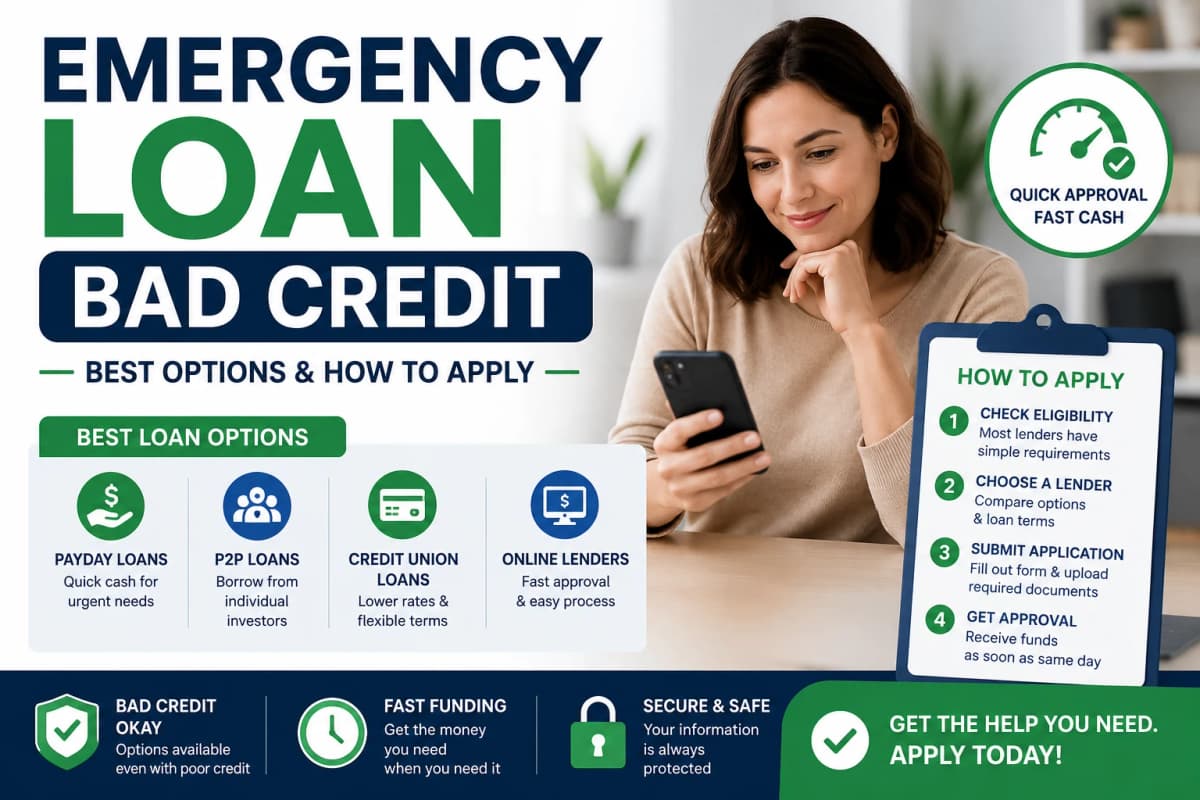
1. Online Personal Loans
Many online companies specialize in "subprime" lending. They use advanced technology to look at your financial health beyond just a single number. They are often the fastest way to get cash.
2. Payday Alternative Loans (PALs)
If you belong to a federal credit union, ask about a PAL. These are small loans designed specifically to help people avoid high-interest payday lenders. They have capped interest rates, making them very affordable.
3. Title Loans
A title loan uses your vehicle as collateral. While easy to get, these are very risky. If you cannot pay the money back on time, the lender can take your car, leaving you in a worse position.
4. Cash Advance Apps
Apps like EarnIn or Dave allow you to borrow a small portion of your upcoming paycheck. There is usually no credit check involved, but the amounts are typically small (under 500 units).
How to Apply for an Emergency Loan with Bad Credit
Applying for an emergency loan with bad credit is a straightforward process, but you should be prepared to act quickly.
Step 1: Check Your Credit Report
Even if you know your score is low, check for errors. Sometimes a simple mistake on your report is dragging your score down. Fixing it could help you get a better rate.
Step 2: Gather Your Documents
Lenders will want to see proof of income. Have your recent pay stubs, bank statements, and a government-issued ID ready. Having these digitized will speed up the online application.
Step 3: Compare Multiple Lenders
Don't take the first offer you see. Use "pre-qualification" tools on lender websites. This allows you to see your potential rate without a "hard" pull on your credit, which protects your score.
Step 4: Read the Loan Agreement
Before you click "accept," look at the Total Cost of Credit. This tells you exactly how much you will pay back in total, including interest and fees.
The Pros and Cons of Bad Credit Emergency Loans
Before committing to an emergency loan with bad credit, it is important to weigh the benefits against the potential downsides.
The Benefits
Speed: You can often get the money within 24 to 48 hours.
Accessibility: You can qualify even if big banks have turned you down.
Credit Building: If you make your payments on time, some lenders report this to credit bureaus, which helps raise your score.
The Risks
High Interest: You will pay more in interest than someone with "good" credit.
Fees: Look out for "origination fees," which are taken out of the loan before you even receive it.
Debt Cycles: If you take out a loan you can't afford, you might find yourself needing another loan just to pay off the first one.
How to Spot a Loan Scam
When you are desperate for an emergency loan with bad credit, you are a target for scammers. Being aware of red flags can save you from a financial disaster.
Red Flag 1: Upfront Fees. Legitimate lenders never ask you to pay money (like a "processing fee" or "insurance") before you receive your loan.
Red Flag 2: Guaranteed Approval. No honest lender can guarantee approval without looking at your financial details. If it sounds too good to be true, it probably is.
Red Flag 3: Pressure to Act Fast. Scammers want you to panic so you don't think clearly. If a lender is threatening you or pushing you to sign immediately, walk away.
Alternatives to Emergency Loans
Sometimes, the best emergency loan with bad credit is no loan at all. Consider these alternatives if you want to avoid more debt:
Payment Plans: Call the company you owe money to. Many utility companies and hospitals offer interest-free payment plans if you ask.
Local Charities: Local churches or non-profits often have small emergency funds to help residents with one-time crises like rent or heat.
Borrow from Family: It can be humbling, but borrowing from a friend or family member is usually interest-free. Just be sure to put the agreement in writing to protect the relationship.
Improving Your Credit for the Future
While you may need an emergency loan with bad credit right now, your goal should be to ensure you don't need one next time.
Start by making every payment on time. Even a single missed payment can hurt your score significantly. Additionally, try to keep your credit card balances low.
Over time, as your score improves, you will qualify for "prime" loans with much lower interest rates. This saves you thousands of units in the long run.
Conclusion
Getting an emergency loan with bad credit is a helpful tool when you are in a tight spot, but it requires caution. By focusing on reputable lenders and understanding the total cost of the loan, you can solve your immediate problem without ruining your future finances. Always prioritize repayment to help build your credit for a more stable tomorrow.
Frequently Asked Questions (FAQs)
1. Will applying for an emergency loan hurt my credit score?
Initially, most lenders do a "soft" credit pull to give you a quote, which does not hurt your score. However, once you officially apply, they do a "hard" pull, which may temporarily drop your score by a few points.
2. What is the maximum amount I can borrow with bad credit?
For an emergency loan with bad credit, amounts usually range from 500 to 5,000 units. The exact amount depends on your monthly income and your state's specific lending laws.
3. Can I get a loan if I am currently unemployed?
It is difficult, but possible. You must show an alternative source of regular income, such as Social Security, disability benefits, alimony, or unemployment checks, to prove you can repay the loan.
4. How long do I have to pay back the loan?
Terms vary by lender. Short-term loans might require repayment in a few months, while personal installment loans for bad credit can give you 12 to 36 months to pay the balance.
5. What happens if I can't make a payment?
If you can't pay, contact your lender immediately. Most prefer to work out a new payment plan rather than have you default. Defaulting will severely damage your credit score and may lead to debt collection.
6. Are online lenders better than local storefronts?
Online lenders often have lower overhead and can offer slightly better rates and faster processing. However, local credit unions offer more personalized service and are usually more regulated and safer than storefront payday lenders.