The 50/30/20 Rule Explained for Beginners
Nobody hands you a financial instruction manual. You finish college, start earning, and suddenly you're supposed to know how to manage a salary, pay rent, save for the future, and still enjoy your life. Most people just wing it. The 50/30/20 rule is one of the clearest starting points I've come across.
So What Exactly Is the 50/30/20 Rule?
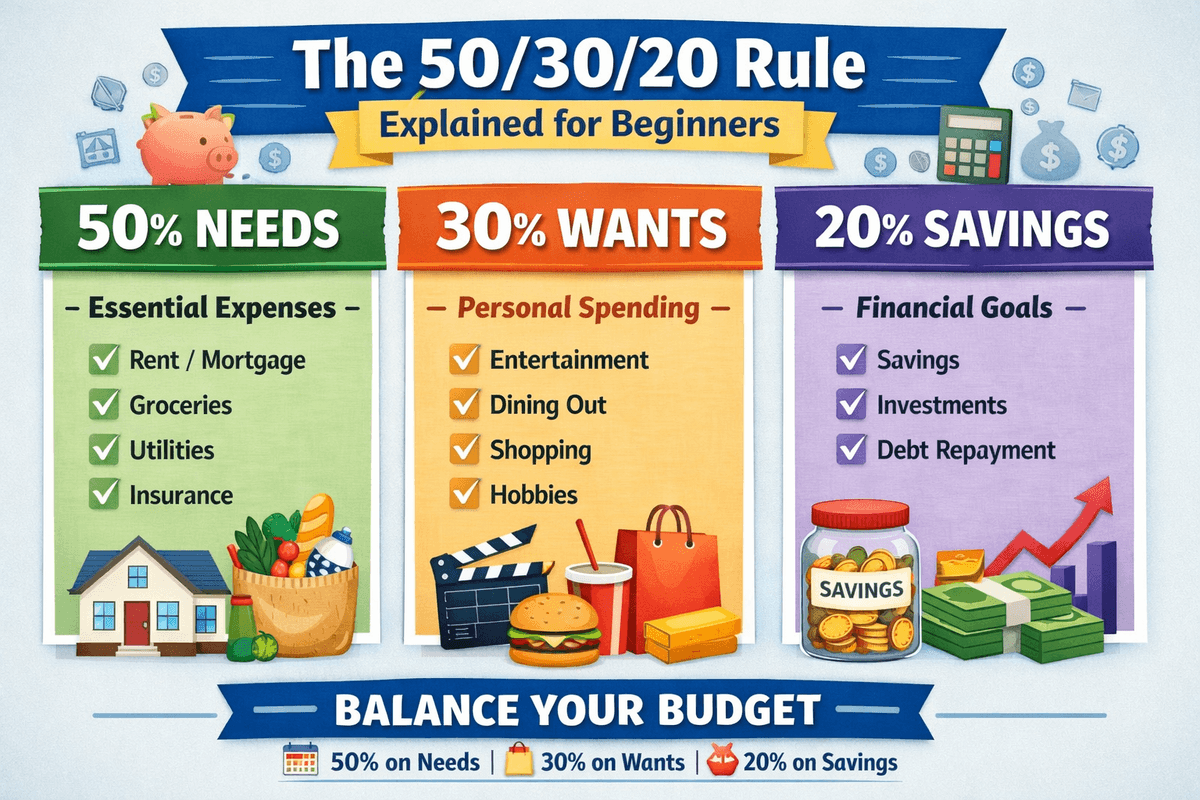
The rule divides your after-tax income into three buckets. Fifty percent goes to needs — rent, groceries, utilities, EMIs, healthcare. Thirty percent goes to wants — dining out, streaming subscriptions, weekend trips, clothes you don't technically need. Twenty percent goes to savings and investments — emergency fund, mutual funds, retirement, or paying down debt faster.
That's it. Three categories. No complicated spreadsheets.
In Indian terms, if you take home ₹60,000 a month, that means ₹30,000 for needs, ₹18,000 for wants, and ₹12,000 for savings or investments. It's not a rigid law — it's a structure. Rent in Mumbai or Bengaluru might eat 40% of your income, and that's okay. The framework helps you see where you stand, not judge you for it.
How to Actually Apply It Without Overthinking
Pull up your last three months of bank statements. Categorise each expense as a need, want, or saving. Add them up. You'll almost certainly find you're spending more on wants than you thought — most people do. That's useful information, not a verdict.
Once you know your current split, decide if it matches what you want. If savings are at 5% and you want to buy a house in five years, something has to shift. Maybe it's cutting subscriptions, maybe it's eating out less — the rule doesn't tell you what to cut. It just makes the trade-offs visible.
Where the 50/30/20 Rule Falls Short
Honestly, 20% savings feels aspirational if you're earning ₹25,000 a month in a metro city. Rent alone can swallow half your income. In those situations, even 10% saved consistently is a win. Don't discard the rule because the percentages don't fit perfectly. Use it as a compass, not a contract.
Conclusion
The 50/30/20 budgeting rule is a starting point, not a final destination. It helps you see your money in three honest buckets — what you must spend, what you choose to spend, and what you keep. Even if the percentages shift based on your city or stage of life, having a structure beats flying blind. Start with awareness. Adjust from there.
FAQs
Q1: Does the 50/30/20 rule work if you earn under ₹30,000 a month?
A: The percentages might not hold, especially in cities where rent alone takes 35–40%. In that case, focus on maintaining any savings rate at all — even ₹2,000 a month. The split is a guide, not a hard rule.
Q2: Should I count SIP investments in the 20% savings bucket?
A: Yes, absolutely. Any money going toward mutual funds, recurring deposits, PPF, or emergency funds counts as your 20%.
Paying off high-interest debt faster also belongs here since it has a guaranteed return equal to your interest rate.
Q3: What's the difference between needs and wants when using this rule?
A: A need is something that keeps your life functional — rent, basic food, transport to work, insurance. A want is everything you enjoy but could theoretically reduce. A ₹199 streaming subscription is a want. The line can blur — and that's fine. Just be honest with yourself when you're categorising.