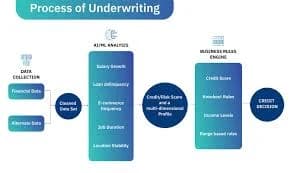
Securing a personal loan from a traditional commercial bank usually requires a long, established credit history. If you have never owned a credit card, taken an EMI plan, or borrowed formal money, your credit bureau report appears completely empty.
In the financial ecosystem, individuals with minimal or zero credit histories are known as thin-file borrowers. Fortunately, a modern collaborative framework called the co lending personal loan underwriting process for thin file borrowers allows lenders to look past standard credit scores to approve applications safely.
This guide will explain how banks and Non-Banking Financial Companies (NBFCs) join forces, share financial risk, and use smart alternative software algorithms to grant credit lines to first-time applicants.
What is the co-lending personal loan underwriting process for thin file borrowers?
It is a joint financial evaluation system where a traditional bank and a tech-driven NBFC analyze a first-time applicant together. Because the borrower lacks a traditional CIBIL score, the underwriting engine uses modern alternative data—like digital cash flows and utility bills—to approve and fund the loan in a shared ratio.
How do co-lenders evaluate credit risk without a standard score?
Lenders bypass the missing credit history by inspecting real-time banking data. The automated system scans your daily savings account transactions, monitors your mobile wallet history, tracks your monthly electricity bill consistency, and analyzes income files from gig work or payroll platforms to calculate your repayment capability.
What is the standard risk split for a thin-file co-lent personal loan?
Under official central bank guidelines, the loan amount and risks are divided between the partners. Typically, the primary commercial bank funds 80% of the personal loan using its low-cost public deposit pools, while the originating NBFC covers the remaining 20% on its own balance books.
The Barrier: Why Thin Files Freeze Traditional Banks
Traditional banking networks rely on a highly conservative risk model. When a customer applies for an unsecured personal loan, the manual underwriting team looks at the applicant's past credit patterns to predict future repayment behavior.
If your file has zero entries, the bank's automated filtering software flags the profile as high risk. The computer cannot distinguish between a responsible beginner and a risky borrower, leading to an immediate digital rejection.
This structural barrier leaves millions of salaried professionals, college graduates, and independent freelancers cut off from formal credit channels. Co-lending solves this exact problem by introducing digital flexibility.
The NBFC's Role: The Tech and Customer Gate
The private NBFC or its integrated fintech partner acts as the primary interface. They use advanced smartphone applications to onboard customers, run paperless identity checks, and collect data logs that traditional branches cannot view.
The Bank's Role: The Affordable Capital Vault
Commercial banks possess massive capital reserves from public savings accounts. By participating in the underwriting chain, the bank provides the bulk of the loan money at low interest rates, keeping the final product highly affordable for the consumer.
Alternative Underwriting Parameters for First-Time Borrowers
When processing a co lending personal loan underwriting process for thin file borrowers file, the shared rules engine looks at alternative digital footprints to build a reliable custom risk score.
These non-traditional data sets act as a digital character report, proving to the underwriting algorithm that you manage your money responsibly.
Bank Statement Analyzers: The platform runs algorithms over your primary bank files to check your average monthly balances and ensure your income outpaces your debit patterns.
Utility and Telecom Consistency: Tracking how regularly you settle your monthly postpaid mobile networks, Wi-Fi lines, and electricity accounts serves as a major consistency metric.
E-Commerce Transaction Patterns: Your historic shopping frequency, refund timelines, and digital payment preferences reveal a clear picture of your disposable income.
Professional and Academic Tracking: For young students or fresh graduates, entering your college record cards or verified corporate employment logs helps establish your career earnings growth path.
Compliance and Consumer Rights Under Co-Lending Rules
The Reserve Bank of India (RBI) manages strict guidelines to ensure that joint lending structures treat everyday consumers with complete honesty and absolute data privacy.
The rules protect you from aggressive underwriting loops and hidden administrative fee markups.
The Single Blended Interest Rate: Borrowers never receive two separate bills. The bank's cheap rate and the NBFC's risk rate are mixed into one single, transparent interest figure.
Unified Asset Classification: Your loan account status is tracked uniformly. If you miss a payment, both lenders update your file matching the exact same calendar milestones.
Strict Single Point of Contact: The originating NBFC remains your dedicated desk for customer care, processing statements, and managing grievance redressal paths.
Conclusion: A Progressive Gateway to Financial Inclusion
Deploying the co lending personal loan underwriting process for thin file borrowers framework marks a massive shift in modern financial equity. It proves that a missing credit score should never lock an honest person out of the formal banking system.
As long as you maintain a clean operational bank account, track your digital spending habits carefully, and clear your joint EMIs before the monthly due dates, co-lending serves as an excellent digital gateway to secure affordable funds while building a powerful credit score for your future.
Frequently Asked Questions
Will taking a thin-file co-lent personal loan help me build a CIBIL score?
Yes, absolutely. Every single monthly EMI payment you make on time is reported to national credit bureaus by both the bank and the NBFC. This continuous positive behavior rapidly builds your credit profile, turning your thin file into a strong history.
Is the underwriting software allowed to read my private WhatsApp text messages?
No, it is completely illegal. Under official digital data privacy guidelines, co-lending applications are strictly prohibited from scraping your personal conversations, browsing your photo galleries, or copying your private phone contacts.
How long does the joint underwriting check take for thin-file borrowers?
Because the underlying technology infrastructure utilizes automated software gates (APIs), the alternative data evaluation, identity verification, and joint credit underwriting choices are completed within 5 to 15 minutes.
What happens to my loan file if the bank and the NBFC risk rules conflict?
The co-lending software operates using a pre-configured master algorithm. If an applicant's data matches the NBFC risk parameters but violates the bank’s core credit rules, the system will automatically drop the joint file or offer a standalone NBFC option.
Are interest rates higher for thin-file personal loans compared to regular loans?
Because first-time borrowers carry a slightly higher risk of default, the blended interest rate can be slightly higher than a premium bank loan. However, it remains much cheaper than independent private loan apps or local marketplace lenders.
Can a self-employed freelancer operating from home clear this underwriting model?
Yes, freelancers can easily qualify. The automated system relies heavily on your actual banking transaction logs and current tax filings over historical credit card accounts, making it a great option for gig-economy workers.