When you step out to turn your dream of homeownership into a reality, you will quickly discover that banks do not just look at your bank balance or company salary slips. Before any lender reviews your structural property blueprints, they request a critical three-digit summary of your financial life.
This numerical report is your CIBIL credit score, and it serves as your primary financial reputation card. If you are preparing to submit an application for a 20 lakh housing loan, knowing where your credit record stands is the single most vital step to preventing sudden branch rejections.
This practical guide unpacks the 20 lakh home loan CIBIL score minimum required across prominent Indian financial institutions. We will look honestly at how your credit score shifts your interest rates and shapes your monthly payments.
Direct Answer Snippets for Quick Reference
What is the 20 lakh home loan CIBIL score minimum required in India?
Most commercial lenders in India enforce a 20 lakh home loan CIBIL score minimum required baseline of 700 to consider your file. While public sector banks might consider a marginal score around 650 with strict income checks, a score of 750 or above is strongly recommended for seamless approval.
Can I secure a 20 lakh home loan with a CIBIL score of 600?
Securing a 20 lakh loan with a credit score of 600 is incredibly difficult through traditional banks. Mainstream lenders treat scores below 650 as a high default risk. You would have to approach specialized housing finance firms, accept a steep interest rate premium, and provide a high down payment.
How does my CIBIL score directly affect my monthly home loan EMI?
Lenders use risk-based pricing to determine your final interest rate structure. A borrower with an excellent CIBIL score of 800 can secure the lowest interest rates, whereas an applicant with a score of 650 might face a higher premium rate, increasing the monthly payment noticeably.
What is a CIBIL Score and Why Do Banks Care About It?
Before diving into the exact benchmarks, let us define what a credit score represents. Generated by credit bureaus like the TransUnion CIBIL company, this three-digit score ranges anywhere from 300 to a maximum perfection of 900.
Your score is calculated by analyzing how responsibly you handled past credit cards, personal loans, or retail EMIs over the trailing few years. It acts as a mirror showing banks your historic repayment discipline.
When you borrow 20 lakhs, the bank is taking a long-term risk on your career and financial habits. A high credit score gives the bank immediate confidence that you will pay back your monthly installments on time without requiring aggressive collection follow-ups.
The Core Scaling: How Your CIBIL Score Controls Your Approval
Indian public sector banks, private institutions, and housing finance networks look at your score using structured risk brackets. Your location on this credit ladder dictates whether your file gets cleared in days or rejected at the login counter.
Let us explore the standard operational credit score brackets used in the Indian lending market:
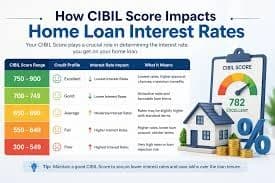
750 to 900 — The Excellent Zone
This is the ultimate gold standard for any home buyer. Holding a score in this top-tier range means you carry zero repayment risk in the eyes of the bank. Lenders will compete for your business, fast-track your file, and grant you their absolute lowest advertised interest rates.
700 to 749 — The Safe Zone
This range fulfills the standard 20 lakh home loan CIBIL score minimum required criteria for nearly all premier banks. Your loan approval path is highly secure, though you might miss out on specialized promotional discounts, resulting in a very slight interest premium.
650 to 699 — The Caution Zone
Your application falls into a grey area. Traditional private sector banks might hesitate to fund your property alone. Public sector banks can still approve your 20 lakh target, but they will likely mandate a higher down payment contribution or demand an excellent, high-earning co-applicant.
Below 650 — The High-Risk Zone
Mainstream commercial banks will almost universally reject your mortgage file at this level. To buy property, you must look toward alternative non-banking financial companies (NBFCs) that operate specialized informal credit check programs.
Real Financial Impact: CIBIL Score vs. Monthly EMI Math
A lower credit score does not just increase your risk of rejection; it directly costs you substantial amounts of hard-earned cash over the course of a multi-decade loan tenure.
Let us look at a direct mathematical simulation for a 20 lakh loan amount stretched across a standard 20-year repayment timeline to see how risk-based pricing alters your household outgoings.
20 Lakh Home Loan Cost Variation Based on CIBIL Score (20 Years Tenure)
Your Active CIBIL Score Range | Approximate Interest Rate | Calculated Monthly EMI | Total Lifetime Interest Burden |
800 and Above | Around 8.15% per annum | 16,920 | 20,60,935 |
750 to 799 | Around 8.25% per annum | 17,043 | 20,90,323 |
700 to 749 | Around 8.35% per annum | 17,166 | 21,19,836 |
600 to 699 | Around 8.75% per annum | 17,666 | 22,39,890 |
As shown clearly in the table, stepping down from an excellent score of 800 to an average credit rating under 700 increases your regular monthly commitment by hundreds of rupees. Over a 20-year cycle, this single credit gap adds nearly 1.79 lakhs in pure, preventable interest expenses to your lifetime bill.
The "New to Credit" Exception: Understanding a -1 or 0 CIBIL Score
If you are a student, a young graduate, or a fresh corporate employee who has never used a credit card or taken a mobile phone loan, your credit report might display a score of -1 or a rating of 0. This status means you are entirely "New to Credit" with zero tracking history.
Do not panic if you fit this description. A score of -1 is vastly superior to a bad score of 550. It simply indicates that the bureau lacks transaction data to evaluate your profile.
For a modest budget target like a 20 lakh housing loan, most public and private banks hold dedicated onboarding frameworks for first-time credit seekers. Lenders will bypass the missing score by performing a deeper manual check of your employer's market reputation, your monthly salary stability, and your regular savings account habits.
Smart and Practical Strategies to Improve Your CIBIL Score
If you discover that your current score sits below the standard 20 lakh home loan CIBIL score minimum required baseline, it is wise to spend six to twelve months repairing your credit record before submitting a formal home loan file.
Use these proven financial habits to rebuild your score safely:
Pay Down Active Unsecured Debts: High outstanding balances on personal lines of credit or multiple credit cards lower your score. Keep your overall credit utilization ratio strictly below 30% of your maximum permissible spending limit.
Automate All Monthly EMIs: Missing a single mobile or car installment can drop your score by tens of points instantly. Use electronic clearing services (ECS) to ensure all recurring dues settle automatically on their exact due dates.
Avoid Submitting Multiple Loan Files: Every time you approach a bank branch for an inquiry, the lender runs a hard check on your profile, which clips a few points off your rating. Use online digital tools to compare rates softly before initiating a formal application.
Conclusion
Fulfilling the 20 lakh home loan CIBIL score minimum required parameter is your vital golden key to unlocking low interest rates and stress-free bank approvals. While a basic score of 700 can help you clear the entry gate, aiming to push your score past 750 saves you substantial cash on your long-term monthly household budget.
Take the time to download your detailed credit report for free online, verify that it contains zero administrative errors, and clear off minor outstanding credit card dues well in advance. With an immaculate credit score and systematic financial habits, your journey toward homeownership will remain completely safe, affordable, and rewarding.
Frequently Asked Questions (FAQs)
1. How long do past defaults or delayed EMIs stay visible on my official CIBIL report?
Any missed payments, credit card delays, or serious loan defaults remain documented on your active credit history records for a rolling window of seven long years. However, the immediate negative impact on your score softens over time if you maintain flawless repayment habits on your newer accounts.
2. Can an error on my credit report cause a bank to reject my 20 lakh home loan file?
Yes, administrative errors like showing an already closed personal loan as an active unpaid debt are common reasons for sudden home loan setbacks. You must check your credit report every year and file quick electronic rectification disputes on the official CIBIL portal to fix any data errors.
3. Will adding a high-credit co-applicant fix my own poor CIBIL score during evaluation?
Bringing in an immediate family member, like your spouse or parent, who holds an immaculate credit score above 750 is an excellent legal workaround. Their strong credit backing acts as an additional safety guarantee for the transaction, allowing banks to clear your 20 lakh loan application despite your lower individual score.
4. What happens to my CIBIL score if I settle a credit card with a lump-sum payment?
Opting for a quick "Settlement" deal with a card company to close a disputed account can hurt your score. The bureau marks the account status as "Settled" instead of "Closed." Traditional banks view a settlement flag as a sign of financial distress and will hesitate to clear long-term housing credit for years.
5. Can a housewife or a student build a high CIBIL score to qualify for a future home loan?
Yes, a student or homemaker can build a strong credit footprint by opening a basic secured credit card backed against a small fixed deposit at their local bank. Making tiny household purchases and paying off the balance on time builds an excellent tracking path in under a year.
6. Do public banks enforce different minimum CIBIL score metrics than private housing firms?
Yes, public sector banks like State Bank of India follow disciplined risk rules but occasionally allow exceptions down to a score of 650 if your government salary or property title is exceptional. Private lenders and housing finance firms maintain highly strict automatic filters at 700 but offer greater flexibility on your overall income scale.