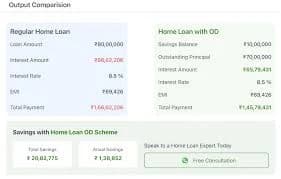
Managing a long-term mortgage can feel like an unending financial weight. Year after year, a significant portion of your standard Equated Monthly Installment (EMI) goes strictly toward clearing the interest balance, while your actual core principal drops very slowly.
To help smart savers break this cycle, major Indian banks offer a unique feature. An overdraft facility against home loan comparison highlights how you can link a current or savings account directly to your housing loan. Any extra cash you park in this linked account instantly lowers your taxable loan interest while keeping your funds completely liquid.
In this comprehensive guide, we will break down the features of the top home loan overdraft products in the current 2026 market, analyze their core features side-by-side, and help you select the ideal lender for your needs.
Direct Answer Snippets for Quick Understanding
What is a home loan overdraft facility?
An overdraft facility against home loan comparison reveals a smart hybrid structure. Instead of a traditional fixed term loan, your housing credit operates as a running overdraft account. Whenever you deposit surplus family savings or business cash into this account, that amount is temporarily subtracted from your principal, drastically lowering your daily interest calculation.
Which Indian bank offers the best home loan overdraft facility?
Top choices in the current Indian banking landscape include public sector giants like the State Bank of India (SBI Maxgain) and Bank of Baroda (Baroda Max Savings). For private sector convenience, institutions like ICICI Bank (Home Overdraft) and Axis Bank provide highly flexible options with digital tracking and integrated transactional debit cards.
Is the interest rate higher for an overdraft home loan?
Yes, most financial institutions apply a slight pricing premium for the freedom of an overdraft loan. When performing an overdraft facility against home loan comparison, you will notice that interest rates for overdraft accounts are typically around 0.25 percent to 0.40 percent higher than standard regular term loans.
How Does a Home Loan Overdraft Account Operate?
To appreciate this financial tool, it helps to see it as a smart container for your active money. In a normal home loan, when you execute a part-payment, that cash reduces your debt forever. If an unexpected emergency occurs next month, you cannot ask the bank to give that money back.
An overdraft scheme solves this issue by offering absolute liquidity. The bank opens a special transaction account where you pay your basic monthly EMIs.
However, you can also use this space to deposit seasonal bonuses, idle festive cash, or business profits. The bank tracks your total outstanding principal balance, subtracts your parked surplus funds, and calculates your interest obligation solely on the remaining net balance every single day.
Comprehensive Banking Comparison Matrix
When looking at an overdraft facility against home loan comparison, evaluating the top public and private sector lenders side-by-side simplifies your final selection.
SBI Maxgain Home Loan
As the largest public sector lender in India, SBI sets the baseline standard with its Maxgain account. It requires a minimum loan threshold of 20 Lakh.
The account provides full operational benefits including a customized debit card and a checkbook. The primary advantage of SBI Maxgain is its massive institutional stability and competitive baseline spread pricing, though the operational underwriting involves manual branch paperwork.
Bank of Baroda (Baroda Max Savings)
Bank of Baroda offers a brilliant alternative called the Baroda Max Savings Home Loan. This product links your mortgage directly to a functional savings bank account.
A standout point for Bank of Baroda is its transparent pricing mechanism and frequent promotional campaigns that offer reduced processing fees. It is highly favored by self-employed traders who need to frequently park large trade surpluses for short durations.
ICICI Bank Home Overdraft
For individuals prioritizing rapid digital processing and smooth mobile applications, ICICI Bank provides an excellent Home Overdraft facility.
ICICI Bank allows you to bring your existing home loan from another institution via a balance transfer and instantly attach a top-up overdraft limit. Their iMobile application makes transferring money between your regular salary account and your overdraft account incredibly smooth.
Key Advantages of Utilizing an Overdraft Mortgage
Choosing an overdraft framework offers immense financial power if you understand how to utilize your revolving cash flow patterns.
Keeping Your Personal Wealth Liquid
You do not have to choose between reducing your debt or keeping an emergency cushion. Your parked cash works continuously to lower your interest bill every day, but it remains accessible. You can pull it out via any standard ATM or net banking link instantly.
Accelerating the Loan Closure Timeline
Because interest is computed on a daily reducing balance method, consistently parking small extra surpluses can significantly lower the total interest component over a 20-year or 30-year span. This natural savings velocity helps close your main principal years ahead of the official schedule.
Critical Trade-offs to Evaluate Closely
While the advantages are highly attractive, an honest overdraft facility against home loan comparison requires evaluating the underlying costs.
The Premium Interest Markup
Banks do not give you unlimited withdrawal freedom for free. Lenders hedge their operational risks by charging a slight markup on the base interest rate. If a regular home loan costs 8.50 percent, the overdraft version will often cost around 8.75 percent to 8.90 percent.
Loss of Specific Tax Deductions
This is a core clause that surprises many tax filers. The extra money you temporarily store inside your overdraft layout does not qualify as a permanent principal repayment under Section 80C. You can only claim tax deductions on the standard principal and interest elements written inside your basic mandatory monthly EMI schedule.
Conclusion
Conducting a detailed overdraft facility against home loan comparison is a smart step toward optimal financial planning. Public sector options like SBI Maxgain and Baroda Max Savings are ideal for long-term safety and competitive rates, while private lenders like ICICI Bank excel in digital account management. If your career brings regular bonuses or you run an active business with rotating cash balances, paying the minor interest premium for an overdraft account is well worth it, allowing you to save substantial interest while keeping your hard-earned wealth accessible.
Genuine Frequently Asked Questions (FAQs)
1. Does the money I park inside a home loan overdraft account earn regular savings interest?
No, the extra funds you park inside an overdraft account do not earn traditional savings bank interest. Instead, they save you from paying high home loan interest on that corresponding portion. Economically, saving interest on a loan is far more profitable and tax-efficient than earning taxable interest on a standard savings deposit.
2. Is there a minimum balance restriction for a linked home loan overdraft account?
No, there is generally no penalty or minimum balance fee if your overdraft account surplus drops to zero. If you withdraw all your extra funds to tackle a personal family emergency, the account simply continues to operate like a normal home loan, and interest calculation shifts back to the full outstanding principal.
3. Can I convert my existing regular home loan into an overdraft account?
Yes, most mainstream banks allow you to convert your running regular term home loan into an overdraft variant. To execute this change, you will need to submit a formal written application at your home branch and pay a nominal internal conversion fee, which typically ranges from 0.25 percent to 0.50 percent of your pending principal.
4. Can a salaried individual benefit from an overdraft home loan comparison?
Yes, salaried professionals can benefit significantly. You can route your monthly salary directly into the overdraft account. The money stays there during the first two weeks of the month before your utility bills, credit card dues, and grocery expenses are paid out, saving you interest on a daily reducing basis during that specific window.
5. What happens if the surplus money I park becomes greater than my total outstanding loan?
If your extra parked funds exceed your outstanding principal, your net interest liability drops to absolute zero. The bank will not charge you any interest for that period. Your standard monthly EMIs will still be deducted to systematically reduce the core principal on record, but no extra interest will pile up.
6. Do banks charge any hidden annual maintenance fees for an overdraft home loan?
Generally, top-tier public sector banks like SBI do not levy any hidden annual book-keeping or maintenance penalties for running a Maxgain account. However, some private sector banks might charge a minor annual renewal fee for the overdraft line, so it is highly recommended to clarify the fee structure before signing your loan agreement.