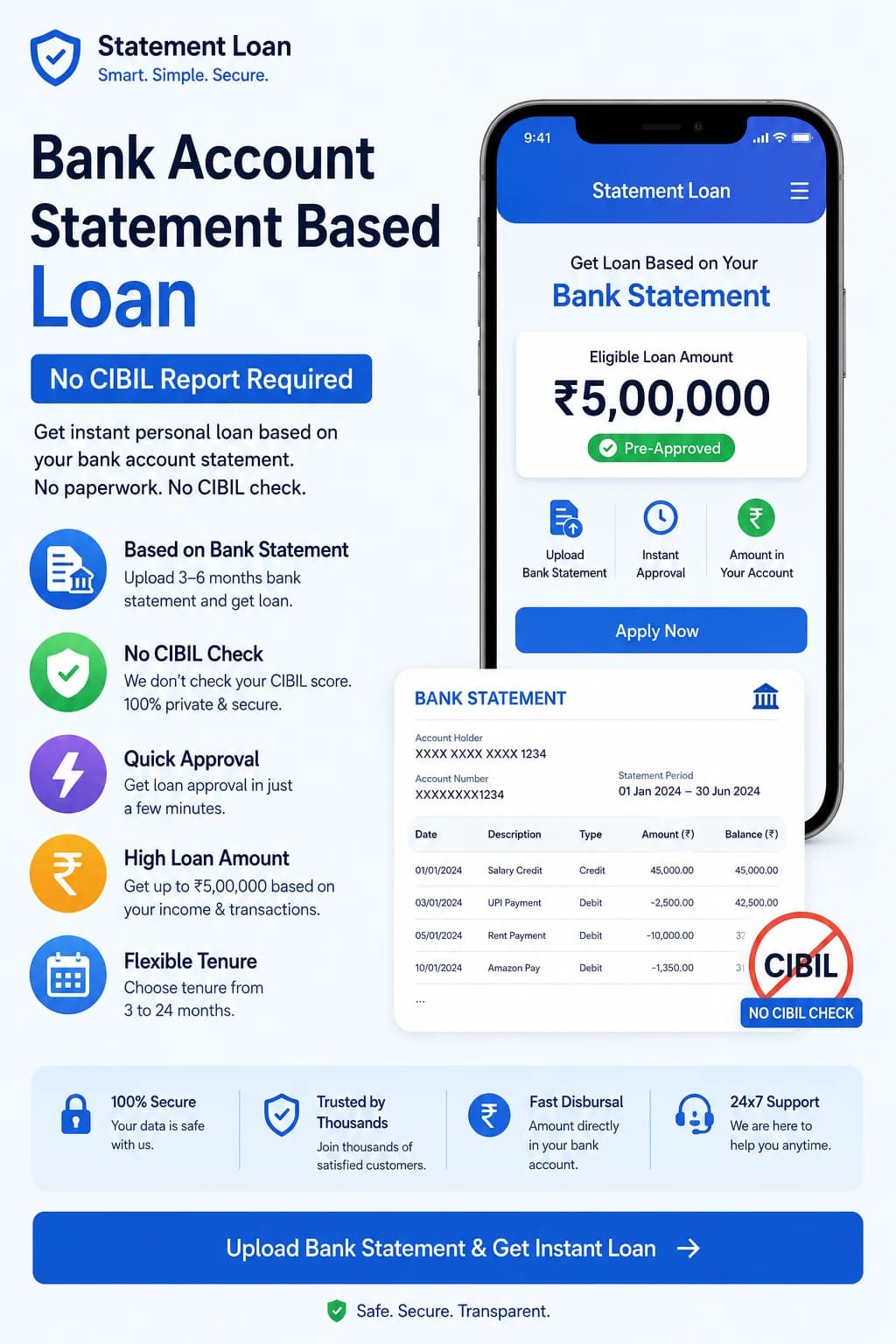
What Is a Bank Statement Based Loan?
A bank statement based loan is a credit facility where the lender evaluates your repayment capacity by analyzing your recent bank transactions rather than just your credit bureau score. This method is common among modern digital lending platforms.
Instead of looking at a three-digit number that summarizes your past debts, these lenders use algorithms to scan your income, spending patterns, and average monthly balance. It is a way to prove you have the "cash flow" to repay the loan, even if you are a first-time borrower.
Why Do Some Lenders Bypass CIBIL Checks?
Traditional banks rely heavily on CIBIL scores because they provide a standardized history of how you have handled debt in the past. However, this system often excludes "thin-file" customers who have never taken a loan before (Ahmed, 2020).
By using alternative credit scoring, some apps can include people who are financially responsible but lack a formal credit history. They look at "non-traditional" data to build a profile of your financial reliability (Ahmed, 2020).
How These Loan Apps Work
When you use a bank statement based loan app, the process is usually fully digital. Once you provide access to your digital statements, the lender’s software reviews your history.
Income Verification: The app checks for regular salary credits or business deposits.
Spending Patterns: They look at your monthly expenses to ensure you have a surplus.
Behavioral Analysis: Some advanced models even look at digital footprints, such as how you pay utility bills or e-commerce habits, to determine risk (Ahmed, 2020).
Understanding the Risks
While it sounds convenient, you must be cautious. Not all "no-CIBIL" loan apps operate fairly. Because these loans are often targeted at "financially stressed" individuals, they can sometimes come with high interest rates or hidden fees (Ramesh, 2022).
Always ensure the platform is regulated. In India, for example, look for apps that are registered as NBFCs or work with authorized banking partners. Avoid platforms that demand excessive permissions on your phone or threaten your privacy with aggressive collection tactics (Ramesh, 2022).
Important Questions to Ask Yourself
Before signing a digital loan agreement, take a moment to consider the total cost. Ask yourself:
What is the annual percentage rate (APR), including all hidden fees?
Is this app recognized by official financial authorities?
Will taking this loan actually help me build my credit for the future?
Many users find themselves in a cycle of debt by taking multiple "instant" loans (Ramesh, 2022). Always treat these loans as a last resort, not a regular source of income.
Snippets: Quick Answers
Can I get a loan if I have no credit score? Yes. Many digital lenders now use "alternative credit scoring" to evaluate your eligibility. By analyzing your bank statements, income regularity, and digital spending patterns, they can estimate your repayment capacity without needing a traditional CIBIL report or a long-established credit history.
Are bank statement based loan apps safe? Safety depends on the specific lender. While technology has made it easier to access credit, you should only use RBI-regulated or government-authorized platforms. Always check for transparent terms, privacy policies, and avoid apps that ask for intrusive mobile phone permissions or charge predatory interest rates.
What should I check before applying for an instant loan? Always check the lender's registration status, the total interest rate, and the repayment schedule. Be wary of "instant" loans that require no paperwork at all, as they often hide high service charges. Ensure you understand the impact of the loan on your long-term financial health.
Conclusion
Getting a bank statement based loan can be a great bridge to financial access if you have a thin credit file. By demonstrating your income and responsible spending through your statements, you can bypass the traditional hurdles of a CIBIL report. However, always prioritize your financial safety by choosing regulated platforms and carefully reviewing the fine print.
Frequently Asked Questions (FAQs)
1. Does a bank statement based loan affect my CIBIL score? Yes, it can. While you may not need a CIBIL score to get the loan, these lenders often report your repayment behavior to credit bureaus. Consistent, timely payments can actually help you build a good CIBIL score for the future.
2. Is it truly possible to get a loan with only a bank statement? Yes, but most lenders will still require basic KYC (Know Your Customer) documents like your Aadhaar card and PAN card. The bank statement serves as your "income proof," replacing the need for salary slips or extensive tax returns.
3. What are the common interest rates for these loans? Interest rates on loans without a CIBIL check are typically higher than traditional bank loans because the lender is taking a higher risk. Always compare the APR across different apps before applying to find the most affordable option.
4. Can students apply for these loans? Generally, you must be at least 18–21 years old and have a steady source of income to qualify for most legitimate lending apps. Some apps may offer specific products for students, but these usually require a parent or guardian as a co-applicant.
5. What happens if I fail to repay a loan from an app? Failure to repay can lead to heavy late fees, aggressive collection calls, and a significant negative impact on your credit history. It will make it much harder for you to get a loan from any bank or legitimate financial institution in the future.
6. How do I know if a loan app is legitimate? Check if the app displays its NBFC registration number on its website. You can also cross-reference the company on the official website of your country's central bank (such as the RBI in India) to see if they are an authorized lender.
References
Ahmed, S. (2020). Alternative Credit Scoring – A Double Edged Sword. Vidhi Centre for Legal Policy.
Ramesh, D. (2022). How Platform-User Power Relations Shape Algorithmic Accountability: A Case Study of Instant Loan Platforms and Financially Stressed Users in India. ResearchGate.