When you see a "settled" status on your CIBIL report, it means you paid less than the total outstanding amount to close a loan. While this might have helped you survive a financial crisis, it now acts as a red flag for lenders. If you are planning to apply for a new loan, you need to address this status to regain your financial credibility.
Many people mistakenly believe that once a settlement is done, the matter is over. Unfortunately, the "settled" tag remains on your credit report for years. This status tells banks that you did not pay back the full amount you borrowed, which makes them view you as a high-risk borrower.
What Does "Settled" Status Mean?
In simple terms, a settlement occurs when a lender agrees to accept a partial payment because you were unable to pay the full debt. The bank marks the account as "settled" rather than "closed."
A "closed" account shows that you fulfilled your entire original agreement. A "settled" account, however, suggests that you struggled with your payments. This distinction is vital because most banks prefer borrowers with a clean "closed" history.
Why You Should Change "Settled" to "Closed"
A "settled" tag can lower your CIBIL score significantly, often by 75 to 100 points. This drop can lead to your new loan applications being rejected or receiving offers with very high interest rates.
By converting this status to "closed," you show future lenders that you have finally fulfilled your full financial obligation. While it does not automatically erase the past, it sends a strong signal that you are now a responsible borrower who has cleared all previous dues.
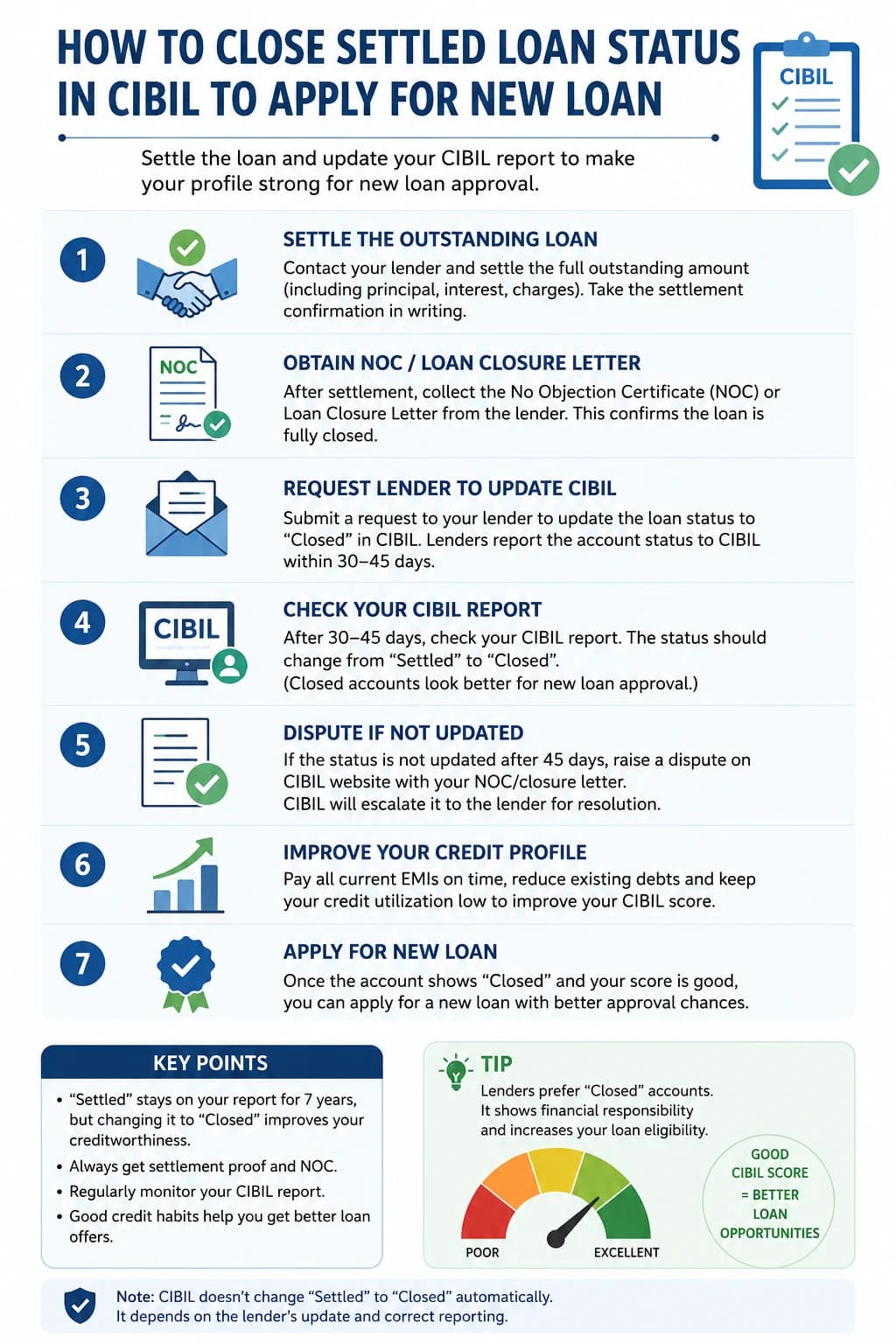
Step-by-Step Guide to Change Settled Status to Closed
1. Contact Your Original Lender
The first step is to get in touch with the bank or financial institution that gave you the loan. You need to ask for the exact remaining balance (the difference between the original settled amount and the full total) required to "close" the account.
2. Pay the Outstanding Balance
Once you have the amount, pay the remaining dues. Make sure you use a proper digital payment method, such as a bank transfer or cheque, and keep the payment receipt as proof. Do not pay in cash if possible.
3. Obtain a No Dues Certificate (NOC)
After you pay the remaining balance, demand a No Dues Certificate (NOC) or a "Closure Letter" from the lender. This document is the most important piece of evidence you will have. It confirms that you no longer owe the bank any money.
4. Monitor Your CIBIL Report
Wait for the lender to update their data with the credit bureau. Banks usually report this information in their monthly or quarterly cycles. Check your CIBIL report after 30 to 45 days to see if the status has changed from "settled" to "closed."
5. Raise a Dispute with CIBIL
If the status has not updated after the expected time, visit the official CIBIL website. You can file a "Dispute" online. During this process, you will need to upload your NOC and payment proof to show that the loan is now fully cleared.
Direct Answer Snippets
What is the fastest way to remove a "settled" status?The only way to change a "settled" status is to pay the full outstanding balance to the lender. Once paid, obtain an official No Dues Certificate (NOC). Use this document to request the lender to update your status to "closed" or raise a formal dispute with the credit bureau.
Will my credit score increase immediately after updating to "closed"?Changing the status to "closed" removes the "settled" tag, which is a positive step. However, your CIBIL score will not jump overnight. You must continue to make all your current EMI payments on time and maintain a low credit utilization ratio to see a steady increase in your score.
Can I get a loan if I have a "settled" status? Yes, it is possible, but it is difficult. Lenders view a settlement as a risk. If you cannot change the status immediately, focus on paying all other debts on time and maintaining a stable income. This helps prove to lenders that your past financial struggle was an isolated incident.
How to Rebuild Your Credit Score After Settlement
After you have successfully updated your status, you should focus on improving your credit health. Start by ensuring all current credit card bills and loan EMIs are paid well before the due date. Consistent, on-time payments are the most powerful way to build a strong credit history.
Additionally, try to keep your credit utilization ratio below 30%. If you have credit cards, do not max them out. Using only a small portion of your available limit shows lenders that you are not desperate for credit and are managing your finances carefully.
Finally, avoid applying for multiple loans in a short period. Each time you apply for a loan, the bank performs a "hard inquiry" on your report, which can slightly lower your score. Apply only when you are confident that your report is in good shape.
Frequently Asked Questions (FAQs)
1. Is it possible to completely erase a "settled" record? No. You cannot delete the history of a settlement if it actually happened. The goal is to update the status to "closed" by paying the remaining dues so that it no longer looks like an active, unresolved problem.
2. How long does the update process take?After you submit your dispute and provide the NOC to CIBIL, the bureau usually takes about 30 days to verify the information with your lender and update your report.
3. Do I have to pay the interest on the settled amount? When you approach the bank to pay the remaining balance, they might ask for the principal amount plus some interest. Negotiate with the bank, but be prepared to pay at least the principal to get the account officially "closed."
4. Will my new loan application be rejected because of a past settlement? Not necessarily. While it is a negative factor, many lenders will still consider your application if you have a high current income, a stable job, and a clean repayment history for the last 12 to 24 months.
5. What if the bank refuses to issue an NOC? If the bank refuses, ask for a written reason. You can escalate the matter through the bank's internal grievance cell or approach the RBI Ombudsman if the bank is not cooperating despite your having paid all dues.
6. Does a "closed" account guarantee a new loan? No. While changing "settled" to "closed" improves your chances, banks still look at your current income, debt-to-income ratio, and other ongoing financial commitments before approving a new loan.
Conclusion
Closing a settled loan status in CIBIL is a crucial step toward fixing your financial reputation. While it requires effort and the repayment of old dues, the long-term benefits for your ability to borrow money are well worth it. By following the steps outlined—clearing the balance, getting an NOC, and ensuring the report is updated—you take control of your financial future. Stay patient, maintain disciplined spending habits, and your credit score will gradually improve over time.