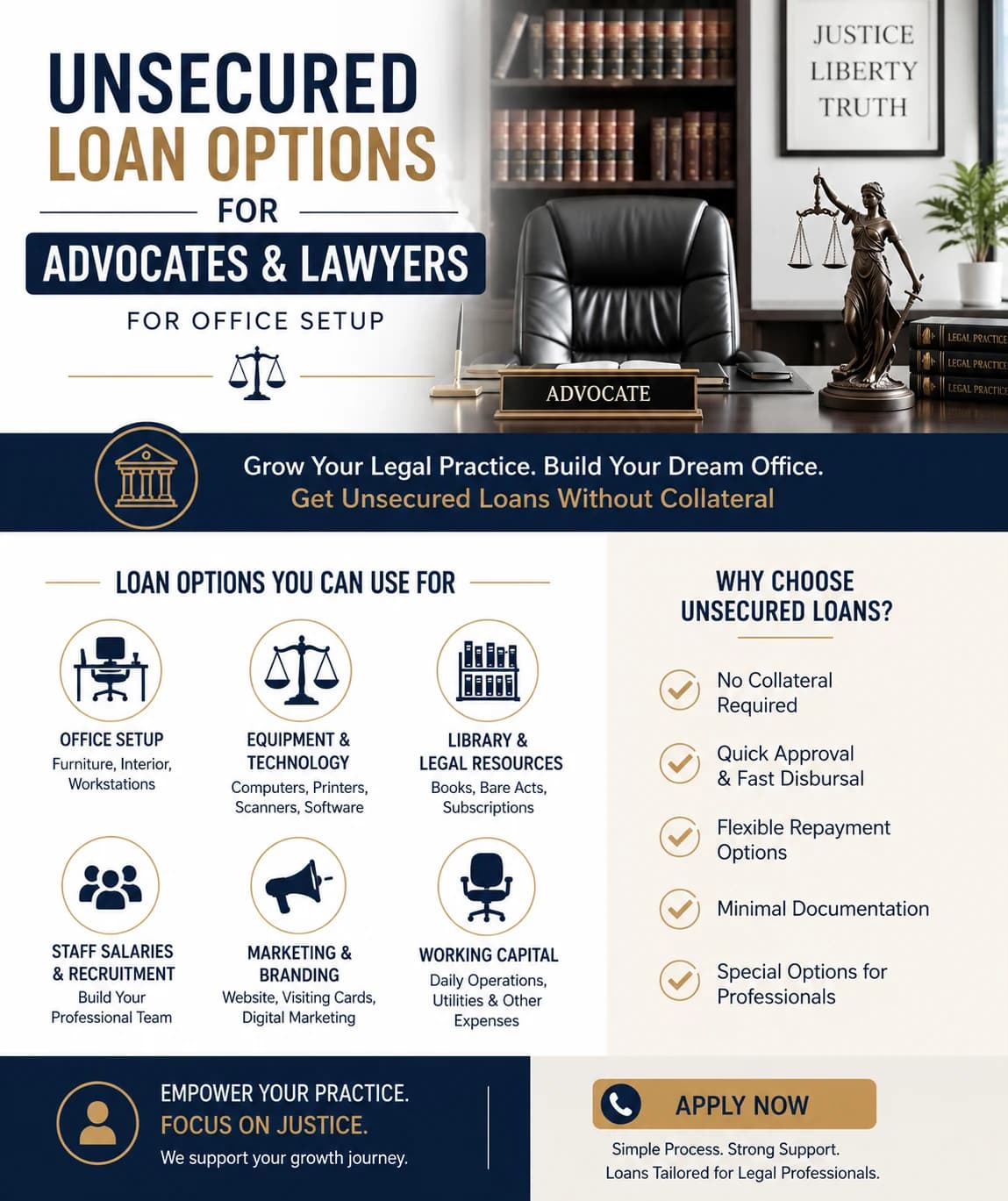
What are the best unsecured loan options for lawyers in India? The most effective options include professional business loans offered by banks and non-banking financial companies (NBFCs), as well as government-backed schemes like MUDRA or CGTMSE-covered loans. These options are specifically designed for professionals to fund office infrastructure, technology upgrades, and furniture without requiring physical collateral.
Can a new advocate get an unsecured loan for office setup? Yes, but lenders usually require a professional degree and proof of practice, such as a Bar Council registration certificate. While new practitioners might have lower loan limits, they can build credibility by maintaining a clean credit history and applying for smaller "Shishu" category MUDRA loans initially.
What documents are needed for a lawyer’s business loan? Typically, you will need your Bar Council enrolment certificate, identity and address proof, income tax returns (ITR) for the last two to three years, bank statements for the past six months, and a professional profile detailing your practice or office setup plan.
Why Choose Unsecured Loans for Law Office Setup?
For many advocates, the primary hurdle to growth is the lack of liquid assets to invest in high-end office infrastructure. Unsecured loans bridge this gap by providing immediate capital based on your professional qualification and income potential.
Unlike secured loans, which require you to put your house or vehicle at risk, an unsecured loan is based primarily on your creditworthiness and your reputation within the legal fraternity.
Benefits of Professional Loans
No Collateral Required: You do not need to provide property as security.
Quick Processing: Since no physical asset appraisal is needed, the approval process is often faster.
Flexibility: You can use the funds for multiple purposes, such as buying furniture, software, or hiring staff.
Eligibility Criteria and Key Requirements
Before you apply, it is essential to understand what lenders look for. While criteria vary by bank, most lenders look for specific indicators of stability.
Essential Eligibility Factors
Professional Qualification: You must hold a valid law degree and be enrolled with a State Bar Council.
Proof of Practice: Lenders generally prefer advocates who have been practicing for at least two to three years.
Credit Score: A healthy CIBIL score is crucial for securing competitive interest rates.
Income Stability: You must provide ITR copies to prove that your legal practice is generating a steady income.
Steps to Apply for Your Office Setup Loan
Getting your loan approved involves preparation and clear communication with your lender. Follow these steps to maximize your chances of approval.
1. Document Preparation
Ensure your professional and financial documents are in order. This includes your Bar Council certificate, ITR filings, bank statements, and any existing business registration proof, such as Udyam registration (MSME).
2. Choose the Right Lender
Compare interest rates and processing fees across different banks, NBFCs, and Small Finance Banks. Public sector banks often offer lower interest rates, while NBFCs might provide faster, more flexible approval processes.
3. Draft a Project Plan
Even if not strictly required, a simple document explaining how you intend to use the funds—such as "purchasing a new desktop, law library expansion, or office interior work"—shows the bank that you have a serious business plan.
Government Schemes for Legal Professionals
The Indian government provides several schemes that can benefit legal professionals. While some are specifically for MSMEs, many law offices can qualify under the services sector category.
MUDRA Loans: Excellent for starting a new office or expanding. The "Shishu," "Kishore," and "Tarun" categories cater to different stages of business growth.
CGTMSE Scheme: This scheme provides a guarantee to banks, making them more willing to lend to professionals without requiring collateral.
Frequently Asked Questions (FAQs)
1. Do I need to be a senior advocate to get an unsecured loan? No, you do not need to be a senior advocate. Any professional advocate with a valid Bar Council license and a consistent income stream can apply for an unsecured business loan.
2. Can I use this loan for personal expenses? No, professional loans are strictly for business purposes, such as office setup, renovation, or purchasing office equipment. Using these funds for personal reasons is generally against the terms of the loan agreement.
3. What is the typical repayment tenure for these loans? Repayment tenures typically range from 12 months to 60 months, depending on the loan amount and the policies of the financial institution.
4. Does the location of my office affect loan approval? Yes, lenders prefer offices in commercial or professional zones. If you are operating from home, some banks might have stricter documentation requirements.
5. How long does the approval process usually take? For unsecured loans, the process can take anywhere from a few days to two weeks, provided all your documentation is clear and your credit profile is strong.
6. Is it better to choose a bank or an NBFC? Banks generally offer lower interest rates but may have stricter eligibility criteria. NBFCs are often more flexible and faster but may charge slightly higher interest rates. Choose based on your urgency and financial comfort.
Conclusion
Securing an unsecured loan for your law office setup is a practical step toward professional growth. By focusing on your credit profile, keeping your financial documentation updated, and exploring both private lenders and government schemes, you can find the capital needed to build a professional workspace. Remember, a well-planned investment in your office today will significantly enhance your practice and client experience tomorrow.