Financial Guide
Buying a dream home is one of the most significant emotional and financial milestones in a person's life. It provides long-term emotional security for your family and serves as a solid physical asset that builds wealth over time. However, very few people can purchase residential real estate entirely out of pocket using hard cash savings.
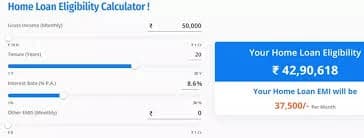
Most buyers rely on financial institutions to fund their purchase. If you earn a stable, take-home income, you are likely wondering exactly how much home loan can i get on 50000 monthly salary in the current real estate market. Lenders do not guess your credit limit; they use structured mathematical equations to see how much you can borrow safely.
In this clear guide, we will break down the two primary evaluation tracks used by major commercial banks, explain how your age and credit score alter your eligibility, and show you how to maximize your borrowing power safely.
Direct Answer Snippets for Quick Understanding
How much home loan can I get on a 50,000 monthly salary?
If you earn a net take-home pay of 50,000 INR, you can typically secure a home loan ranging between 25 Lakh and 36 Lakh. The exact approved amount depends heavily on your chosen repayment tenure, prevailing market interest rates, your current credit score, and whether you carry any active monthly EMI obligations.
What is the bank multiplier method for home loan eligibility?
The multiplier method is a fast tracking tool used by public lenders like the State Bank of India. Lenders multiply your gross take-home monthly pay by a fixed factor, usually up to 72 times. Applying this specific rule means a 50,000 INR monthly income directly translates to a maximum borrowing cap of 36 Lakh.
How does the FOIR rule affect my housing loan eligibility?
The Fixed Obligation to Income Ratio (FOIR) dictates that your total monthly debt obligations—including your future home loan EMI—should never cross 50 to 55 percent of your net income. For a 50,000 INR salary, your maximum allowable monthly EMI basket is capped at approximately 25,000 INR to 27,500 INR.
Understanding the Fixed Obligation to Income Ratio (FOIR)
Before approving a multi-decade loan, banks want absolute assurance that you can comfortably manage your monthly installments without facing severe household budget strain. The primary tool used to measure this risk is the FOIR metric.
Lenders assume that an individual requires at least 45 to 50 percent of their monthly salary to cover basic living expenses, such as grocery bills, house rent, children's school fees, and medical insurance. Therefore, the remaining portion represents the absolute maximum space available for loan EMIs.
If your current bank statement shows zero active loans or credit card debts, the bank opens up a full 50 percent allotment block for your future house. This means you can comfortably dedicate up to 25,000 INR every single month toward your new home loan EMI.
Applying the Net Monthly Income Multiplier System
Another traditional screening standard utilized across public banking networks is the Net Monthly Income (NMI) multiplier system. This method bypasses complex math and looks directly at your annual earning capacity.
Public sector banks regularly offer housing credit limits that scale up to 6 times your gross annual salary, or 72 times your net monthly salary. Let us map out the baseline calculation sequence assuming you hold zero past financial debts:
$$\text{Maximum Multiplier Loan Limit} = \text{Net Monthly Salary} \times 72$$
$$\text{Maximum Multiplier Loan Limit} = 50,000 \text{ INR} \times 72 = 36,00,000 \text{ INR}$$
This simple equation demonstrates that 36 Lakh serves as the absolute upper ceiling for an independent individual earning a 50,000 INR salary pocket. If a property dealer tries to push you toward a 50 Lakh luxury apartment, you will need to bring in extra family funds to bridge the gap.
Real-World Example of Tenure and Interest Variations
To see how your real-world credit limits alter based on market conditions, let us analyze a practical scenario using a standard home loan interest rate of 8.50 percent per annum. Lenders adjust your final sanctioned capital based on the number of years you choose to repay.
The 20-Year Repayment Timeline
If you opt for a 20-year tenure to clear your debt quickly, an EMI allocation of 25,000 INR per month will allow you to borrow approximately 28.7 Lakh. Choosing a shorter timeline keeps your total lifetime interest outgo low, but limits the total property value you can target.
The 30-Year Repayment Timeline
If you stretch your repayment journey to the maximum allowable limit of 30 years, that same 25,000 INR monthly EMI allowance allows your eligible loan size to scale up significantly, touching approximately 32.5 Lakh.
The structural relationship between your variables operates using this standard path:
$$\text{Eligible Home Loan Funding} = f(\text{Monthly Income}, \text{Tenure Months}, \text{Interest Rate Percentage})$$
Stretching your loan term makes your monthly payments more manageable and helps you qualify for a larger initial loan amount. However, keeping a loan active for 30 continuous years means interest ticks for more months, making the total cost of the house substantially higher.
Key Factors That Can Lower Your Approved Loan Size
Even if your income file reads a perfect 50,000 INR, credit underwriters can slash your approved funding line if your profile carries hidden risk flags.
1. Active Car Loans or Personal EMIs
This is the most common reason first-time buyers face disappointment. If you are already paying a monthly installment of 7,000 INR for a car or smartphone, the bank will subtract that obligation directly from your FOIR basket. Your available EMI limit drops from 25,000 INR down to 18,000 INR, reducing your loan eligibility.
2. A Damaged Credit History (Low CIBIL Score)
Your personal credit rating acts as a mirror of your past financial discipline. Most premier lenders look for a healthy CIBIL score of 750 or higher. If your credit track is bruised due to past delayed credit card payments, banks will either reject the file or apply a high interest rate premium, which lowers your total loan eligibility.
3. Your Current Age and Working Horizon
Home loans are long-term commitments that must be fully paid back before you reach your official retirement age (usually 60 years for salaried corporate workers). If you apply for a loan at age 25, you can easily access a comfortable 30-year tenure. If you apply at age 45, the bank will cap your tenure at 15 years, causing your eligible loan amount to drop.
Smart Strategies to Boost Your Home Loan Eligibility
If your current independent salary limit falls short of the property price tag you want to buy, you can use a few strategic banking steps to improve your application profile.
Step 1: Add an Earning Co-Applicant
This is the single most effective way to rescue a weak application file. You can add a close family member—such as your spouse, working parent, or immediate sibling—as a joint co-borrower. Lenders will pool both income streams together. If your combined household pay climbs to 90,000 INR, your available loan bracket can instantly cross the 55 Lakh mark.
Step 2: Clear Minor High-Interest Debts
Before handing your bank statements to a mortgage officer, clear all small outstanding liabilities. Pay off active credit card balances and close minor personal loans early. Securing formal No Objection Certificates (NOCs) to show zero active debts expands your available FOIR block, allowing the bank to grant you more cash.
Step 3: Accumulate a Larger Down Payment
The central bank enforces a strict Loan-to-Value (LTV) rule, stating that commercial banks can only fund 80 to 90 percent of a property's official technical valuation. If you save aggressively to pay 25 to 30 percent of the apartment cost as an upfront down payment, you lower your total borrowing requirement, making your application highly secure for the bank.
Conclusion
Finding out how much home loan can i get on 50000 monthly salary highlights that a stable income can comfortably secure a reliable asset worth 25 Lakh to 36 Lakh. By understanding how lenders use the 50 percent FOIR safety cushion and the 72-times annual income multiplier track, you can plan your property search intelligently without falling into dangerous debt traps. Keep your family credit file clean, optimize your loan tenure based on your retirement horizon, and explore joint co-applicant strategies to ensure your home ownership journey stays safe, affordable, and entirely successful.
Genuine Frequently Asked Questions (FAQs)
1. Does a 50,000 monthly salary loan include the registration and stamp duty costs?
No, standard home loan sanctions cover strictly the basic cost of the physical building structure. Additional property acquisition fees—such as local municipal stamp duty, government registration charges, property tax filings, and society maintenance deposits—must be paid directly out of your own personal savings pocket.
2. Can I use the SBI MaxGain overdraft facility if I earn 50,000 per month?
Yes, you can opt for the SBI MaxGain home loan variant if your overall eligibility clears the bank's baseline criteria. This specialized product operates as a running overdraft account where you can park any spare household cash to lower your active daily interest charges, while maintaining full freedom to withdraw the money whenever you face an emergency.
3. Is it possible to secure a home loan if my 50,000 salary is paid in cash?
Securing a high-value mortgage loan becomes exceptionally difficult if your salary is handed over as physical cash. Traditional commercial banks require your monthly take-home pay to be routed via electronic bank transfers, backed by regular corporate salary slips, valid Form 16 documents, and active Income Tax Returns (ITR).
4. What is the minimum property down payment required for an eligible 30 Lakh loan?
Under standard Reserve Bank of India (RBI) risk frameworks, commercial banks can fund a maximum of 80 to 90 percent of the property's verified market valuation. For a target loan asset valued around 30 Lakh, your family must bring in a minimum ten to twenty percent cash margin, meaning you need 3 Lakh to 6 Lakh as an upfront down payment.
5. Can a freelance worker or self-employed retailer get the same loan size as a salaried worker?
Yes, independent freelancers and self-employed shopkeepers can secure identical loan amounts. However, since their monthly income lacks corporate salary slips, credit managers will evaluate their financial health by checking their audited business balance sheets, past two years of active profit and loss statements, and consistent GST filings.
6. Are there any hidden penalties if I pay off my home loan early using a lump-sum bonus?
No, according to mandatory consumer protection directives set by the central bank, Indian lenders are strictly prohibited from imposing early foreclosure fees or prepayment penalties on individual floating-rate home loans. You can make partial principal prepayments or close the entire account early for zero extra cost.