Managing a corporate credit account or tracking a startup's debt facility requires a solid grasp of financial mathematics. Across diverse business operations—whether you are managing verified corporate purchases for technology startups, arranging international trade finance for global export houses, preparing for multi-million venture capital rounds, or tracking rental cash flows from premium commercial real estate properties leased to multinats—financial accuracy is essential.
When a company experiences a brief cash flow delay and misses an Equated Monthly Installment (EMI), commercial banks apply overdue interest calculations. Following the latest national fair lending guidelines, lenders must isolate your core debt balances completely. Learning how to calculate compounding interest on unpaid principal component excluding penalties protects your corporate balance sheet from illegal fee structures.
This introductory guide simplifies the math behind modern loan default calculations, outlines the step-by-step formula used by automated banking portals, and demonstrates how consumer protection laws keep your late fees completely separate from interest-bearing balances.
How do you calculate compounding interest on unpaid principal component excluding penalties?
To calculate this value, you must apply your contracted interest rate strictly to the delayed principal slice of your loan installment. You must completely exclude any flat late fees, bounce charges, or administrative penalties from this baseline pool, ensuring that your penalty balance remains zero-interest over time.
Why do banking laws ban compounding interest on top of penalties?
Banking regulations ban this practice to stop lenders from running compounding debt traps. By forcing banks to separate punitive fees into an isolated ledger, the law ensures that a minor administrative mistake or document delay cannot permanently expand your interest-bearing principal pool.
What mathematical components can legally compound after a loan default?
Under standard credit guidelines, banks can legally continue to calculate standard contracted compound interest only on your unpaid principal balances and legitimate outstanding interest components. All applied punitive default flags must sit in an independent, flat fee ledger that never generates daily or monthly compound interest.
The Core Concept: Isolating the Core Debt Pool
To understand modern loan math, you must first look at how an EMI is constructed. Every monthly payment is divided into two separate components: a principal component (which reduces your actual loan balance) and an interest component (the bank's fee for lending you cash).
When an export house or a tech company misses a monthly payment run, the bank's accounting software breaks the default down into distinct ledger blocks. The system marks your core installment elements alongside any fresh penalty fees issued for missing the deadline.
[Default Event Occurs] ➔ [Isolate Unpaid Principal Component] ➔ [Apply Base Compound Interest Rate]
                       ➔ [Isolate Punitive Penal Charges]   ➔ [Apply FLAT Fee Layer (Zero Interest Added)]
The crucial rule of modern financial accounting is that these blocks can never touch. The system tracks your core principal separately, running compound interest calculations strictly on that balance while leaving the penalty box completely free from extra interest additions.
The Mathematical Formula for Overdue Interest
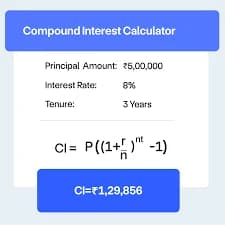
To compute the regular interest on your delayed principal balance, lenders utilize the standard compound interest equation adapted for a daily or monthly tracking matrix.
$$A = P \times \left(1 + \frac{r}{n}\right)^{n \times t}$$
When calculating the regular interest on your overdue account balance under modern compliance terms, the variables are restricted to core debt values:
$A$ (Total Outstanding Core Balance): The final accumulated debt amount before penalties are added.
$P$ (Unpaid Principal Component): The exact, isolated portion of the principal balance that remains delayed. This completely excludes flat late fees.
$r$ (Contracted Interest Rate): The standard annual interest rate written into your primary loan agreement.
$n$ (Compounding Frequency): The number of times interest compounds per year (typically $n = 12$ for monthly compounding cycles).
$t$ (Time in Years): The exact duration the payment remains missing, calculated as the number of delayed days divided by 365.
By locking the value of $P$ to the core principal element alone, the resulting asset matches national fair lending parameters perfectly.
Step-by-Step Practical Calculation Example
Let's walk through a realistic business example to see exactly how these ledger entries operate on a standard corporate loan profile.
Imagine a technology startup holds an outstanding term loan balance featuring a contracted interest rate of 12% per annum, compounded monthly. The company misses an installment where the specific unpaid principal component equals one lakh rupees. The bank also applies a flat, non-capitalized penal charge of five hundred rupees for missing the deadline. The delay lasts for exactly 30 days.
Step 1: Isolate the Calculation Input Values
Identify your core variables while completely setting aside the penalty fee:
Unpaid Principal ($P$) = 1,00,000 rupees
Annual Interest Rate ($r$) = 0.12
Compounding Frequency ($n$) = 12 (Monthly)
Time Profile ($t$) = 1 month (or 1/12 of a year)
Step 2: Compute the Monthly Interest Factor
Divide the annual interest rate by the compounding frequency:
$$\frac{0.12}{12} = 0.01$$
Step 3: Calculate the New Core Balance
Apply the monthly interest factor to the isolated principal component:
$$A = 1,00,000 \times (1 + 0.01)^1$$
$$A = 1,00,000 \times 1.01 = 1,01,000\text{ rupees}$$
Step 4: Extract the Net Regular Overdue Interest
Subtract the initial principal from your calculated balance to find your regular overdue interest cost:
$$1,01,000 - 1,00,000 = 1,00,000\text{ rupees}$$
Step 5: Assemble the Final Statement Summary
The bank's automated system summarizes your total liability by stacking the isolated components cleanly:
Unpaid Principal Balance: 1,00,000 rupees
Regular Overdue Interest (30 Days): 1,000 rupees
Isolated Flat Penal Charge: 500 rupees
Total Outstanding Account Balance: 1,01,500 rupees
Because the flat penalty fee of five hundred rupees was kept completely outside the compounding equation, your total bill scales linearly without generating secondary interest loops.
Key Operational Protections for Business Accounts
Enforcing the how to calculate compounding interest on unpaid principal component excluding penalties workflow ensures that business owners can protect their credit profiles during short-term capital dry spells.
Corporate risk officers and accounts teams must monitor their monthly statements to verify that their banks follow these structural protections.
No Risk Premium Modifications: Banks cannot use a minor document delay or a missed payment run to permanently increase your primary interest rate under alternative names like "risk adjustments."
Pro-Rata Time Apportionment: Late interest and penal fees must track your timeline with absolute precision, calculating charges strictly for the exact number of days your payment remains missing past the grace window.
GST Application Protections: Any applied Goods and Services Tax (GST) is calculated solely over the isolated penal fee amount, keeping your core loan principal pool completely free from extra tax loops.
Conclusion: Maintain Absolute Transparency in Financial Math
Mastering how to calculate compounding interest on unpaid principal component excluding penalties calculations is an essential skill to run a healthy, compliant business enterprise. It ensures that corporate financial officers stay in complete control of their balances during short-term market disruptions.
As long as you monitor your monthly account summaries with strict discipline, track your documentation submissions using a clear compliance calendar, and partner with transparent commercial banking channels, you can easily protect your corporate credit rating, satisfy national audit teams, and drive stable business growth.
Frequently Asked Questions
Can a commercial bank charge regular interest and a penal charge at the exact same time?
Yes. If you miss a scheduled monthly loan payment, the bank will calculate regular overdue interest on the delayed principal balance to cover the extra time you held their capital. Simultaneously, they will apply a flat, non-capitalized penal charge as a disciplinary penalty fee for missing the deadline.
What should I do if my bank statement shows interest being calculated on top of a late fee?
If you spot an unauthorized interest charge computed over a penalty fee on your statement, file an immediate dispute with your bank's internal grievance desk. If the branch fails to correct the software error within thirty days, you can escalate the file straight to the central RBI Banking Ombudsman portal.
Are credit card accounts covered under these non-capitalization safety rules?
No, credit card lines are completely excluded from this specific protective framework. Credit cards operate under an independent set of central bank master guidelines designed for high-risk revolving consumer accounts, which explicitly permit providers to compound overdue balances and late fees under distinct credit terms.
What does it mean when a bank adds a legal charge or hypothecation to my assets?
A legal charge or hypothecation means the bank registers a temporary security claim over your commercial properties or automated equipment as a backup for your loan. You continue using the assets daily, and the bank removes its name entirely once your loan balance hits absolute zero.
Can a bank increase its flat penalty fees midway through my business loan term?
No, lenders cannot alter your penalty parameters arbitrarily midway through a loan term. All potential penalty amounts and specific compliance reasons must be clearly disclosed upfront within your loan agreement and cannot be raised unless your account undergoes a mutual contract renewal.
Does the ban on compounding penalties apply if a loan drops into a Non-Performing Asset category?
Yes, absolutely. Even if a business faces severe financial hurdles and the loan account drops into a Non-Performing Asset (NPA) category, the commercial bank remains legally bound by fair lending rules, meaning they can never calculate interest on top of accumulated penal charges.