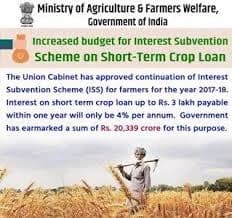
What are the interest subvention benefits for on-time repayment of crop loans?
The interest subvention benefits for on-time repayment of short term crop cultivation loans provide an extra three percent interest discount to disciplined borrowers. While the government subsidizes the initial standard crop loan rate down to seven percent, paying back your debt before the annual due date drops your final effective interest rate to just four percent.
How does the prompt repayment incentive modify short term crop loan costs?
The prompt repayment incentive modifies credit costs by rewarding on-time payments with a direct cash-back rebate. When a farmer clears their seasonal agricultural credit within the bank's twelve-month deadline, the central banking system automatically calculates a three percent interest credit and deposits those savings back into the borrower's account.
What is the maximum loan limit eligible for farming interest subventions?
The maximum limit eligible for agricultural interest subventions is capped strictly at three lakh rupees per individual borrower. Short-term cultivation credit lines that cross this three-lakh-rupee threshold do not qualify for central interest discounts, and the excess borrowing amount attracts standard commercial banking interest rates.
TITLE: Interest Subvention Benefits for On-Time Repayment of Short Term Crop Cultivation Loans
Securing affordable operational capital is the primary requirement that keeps seasonal farming operations moving forward smoothly. To protect rural communities from high-interest informal moneylenders, the government provides highly subsidized credit paths through the Kisan Credit Card system.
While these institutional farm loans are already priced much lower than standard personal credit lines, you can unlock even deeper discounts. Claiming the interest subvention benefits for on-time repayment of short term crop cultivation loans allows disciplined savers to slash their financing costs significantly.
This educational handbook breaks down the exact interest calculation rules, annual deadlines, and processing tracks managed by nationalized banks. We will explain how prompt payments alter your loan statements so you can maximize your seasonal agricultural savings with complete confidence.
Understanding the Two-Layer Interest Subsidy Framework
The central government structures its agricultural credit support programs in two distinct layers to encourage both financial inclusion and repayment discipline. The first layer is a general interest subsidy available to all eligible crop loan applicants on day one.
Standard commercial loans usually carry market interest rates well into double digits. To make cultivation affordable, the state provides a baseline interest subvention that automatically brings the standard crop loan interest rate down to seven percent per annum.
[Standard Commercial Bank Interest Rate]
                       │
                       ▼  (Layer 1: General Subvention Discount)
[Standard Base Crop Loan Interest Rate: 7%]
                       │
                       ▼  (Layer 2: Prompt Repayment Incentive)
[Final Effective Interest Rate for On-Time Payers: 4%]
The second layer of savings is explicitly tied to your personal banking behavior and financial discipline. If you settle your accounts promptly within the bank's timeline, the state triggers an additional three percent prompt repayment incentive, dropping your final effective interest rate to just four percent.
Navigating Annual Due Dates and Account Reset Rules
To claim these lucrative interest subvention benefits for on-time repayment of short term crop cultivation loans, you must understand how bank billing cycles operate. A short-term crop loan is not designed to run as a multi-year continuous debt block without intermediate adjustments.
Lenders grant short-term cultivation lines for a maximum duration of twelve months per seasonal cycle. This means you must clear your entire outstanding interest outgo and principal balance at least once a year to reset your credit line.
The exact due date for your account adjustment is explicitly printed on your loan sanction documents. This date is timed by regional agricultural committees to match local harvesting and crop marketing windows, giving you ample time to sell your produce before payments come due.
The True Value of Maintaining a Spotless Repayment Track
Paying back your short-term cultivation credit lines on time delivers massive financial advantages that look excellent on your long-term bank files. The most immediate benefit is the direct cash-back savings generated by the three percent prompt repayment rebate.
Furthermore, banks reward disciplined borrowers by automatically expanding their overall credit limits for the upcoming agricultural year. Under standard guidelines, your card limit can grow by ten percent each season up to the fifth year if your account remains perfectly clear.
Credit Score Impact: Settle your seasonal farm debts before the official due date protects your personal credit profile from default markers. A high credit score opens doors to larger agricultural term lines for buying heavy machinery or setting up advanced irrigation facilities.
Crucial Statutory Limits and Exclusions to Monitor
While the interest subvention framework is highly supportive, central authorities enforce strict boundaries to prevent the misallocation of welfare funds. These rules ensure that subsidized credit lines directly support active food production rather than speculative investments.
The maximum aggregate loan principal eligible for these combined interest subventions is capped strictly at three lakh rupees per individual file. If a producer takes out a large credit line crossing three lakhs, the interest subvention benefits for on-time repayment of short term crop cultivation loans apply only to the first three lakhs.
Understanding Exclusions for Allied Agricultural Setups
The state also tracks your specific farm activities to determine your final interest subsidy brackets. If you use short-term credit solely to manage allied activities like dairy units, poultry houses, or inland fisheries, different subvention ceilings apply.
[Total Short-Term Credit Portfolio]
                  │
                  ├─► Pure Crop Cultivation Loans ──► Subsidized up to 3 Lakh Rupees Max
                  └─► Allied Agricultural Credit  ──► Subsidized up to 2 Lakh Rupees Max
For standalone animal husbandry and fisheries activities, the maximum loan limit eligible for the subsidized seven percent rate is restricted to two lakh rupees. However, if a borrower runs both traditional crop fields and allied livestock units together, the maximum combined subvention cap remains locked at three lakh rupees.
Repayment Timing Profile | Initial Base Interest Rate | Prompt Repayment Rebate | Net Effective Interest Cost | Next-Year Credit Limit Impact |
|---|---|---|---|---|
Prompt Settlement (Paid before the due date) | 7% per annum | 3% direct deduction | 4% per annum final cost | Qualifies for an automatic 10% limit expansion |
Delayed Settlement (Paid after the due date) | 7% per annum | 0% (Rebate is canceled) | 7% per annum up to due date | Credit limit stays frozen or drops down |
Chronic Default (Unpaid past 12 months) | Rates scale up | 0% (Rebate is canceled) | Standard commercial rates apply | Account is flagged and legal notices are issued |
Step-by-Step Guide to Maximizing Your Interest Subvention Benefits
To ensure you successfully claim your interest rebates and keep your borrowing costs down to four percent every single year, follow this organized sequence of steps.
1
Track Your Official Loan Due Date
Phase 1
1.Track Your Official Loan Due Date:Phase 1.
Review your official Kisan Credit Card sanction paperwork or visit your local branch to note the exact deadline date assigned for your annual account review.
2
Deposit Your Crop Revenues Early
Phase 2
2.Deposit Your Crop Revenues Early:Phase 2.
Once you sell your seasonal harvest at local market yards, deposit the revenue straight into your KCC account to clear your active principal and interest balances.
3
Verify the Prompt Repayment Credit
Phase 3
3.Verify the Prompt Repayment Credit:Phase 3.
Check your updated bank passbook statement after thirty days to confirm that the bank's system has credited your three percent interest rebate cash back safely.
4
Renew Your Credit Line Instantly
Phase 4
4.Renew Your Credit Line Instantly:Phase 4.
Withdraw your fresh, expanded crop cultivation funds the very next day to launch your upcoming sowing operations with zero capital shortages.
Conclusion
Mastering the mechanics of interest subvention benefits for on-time repayment of short term crop cultivation loans turns a basic seasonal liability into a highly effective tool for wealth preservation. The banking network is explicitly designed to reward financial discipline, making it highly advantageous to clear your debts on schedule.
A final interest rate of just four percent represents the most affordable formal credit line available anywhere in the modern financial world. By avoiding small delays, you keep your hard-earned profits in your own pockets instead of letting them slip away into unnecessary penalty charges.
By following official bank application tracks and keeping your transaction records perfectly clean, you can build your enterprise with absolute peace of mind. Transforming a standard crop loan into a highly efficient, ultra-low-cost farming resource becomes a clear, deeply profitable step toward achieving long-term agricultural stability and economic freedom.
Frequently Asked Questions (FAQs)
1. Does the three percent prompt repayment incentive apply if I pay my loan just one day after the due date?
No, the central banking computer systems calculate interest subvention rebates using strict, automated digital parameters. To qualify for the extra three percent prompt repayment incentive, your full outstanding interest dues must be paid into your account on or before the exact due date printed on your documents. Even a single day of administrative delay will cause the system to cancel your eligibility, forcing you to pay the full seven percent baseline interest charge for that cycle.
2. Can a farmer claim Section 80C income tax deductions on short-term crop loan principal repayments?
No, principal repayments made toward short-term agricultural crop cultivation loans do not qualify for tax deductions under Section 80C of the Income Tax Act. Section 80C tax benefits are strictly reserved for specific long-term asset-creation paths, such as primary home loan principal repayments, equity-linked savings schemes, or life insurance premiums. Short-term crop loans are categorized as operational working capital lines, which completely excludes them from Section 80C write-offs.
3. What happens to my interest subvention benefits if my village faces severe seasonal crop failure due to drought?
If your local region faces widespread crop damage caused by natural disasters like severe drought or extreme floods, the state government can step in with official relief packages. Under central rules, banks can convert your short-term crop loans into long-term relief term loans. When this formal conversion occurs, your initial one-year interest subvention benefit is preserved, and the bank waves late-payment penalties to help your farm recover without hurting your credit score.
4. Is it mandatory to buy crop insurance to qualify for short-term interest subventions?
Under updated agricultural lending guidelines, enrolling your seasonal crops in the Pradhan Mantri Fasal Bima Yojana, or PMFBY, has been made completely voluntary for loanee farmers. You have full freedom to opt out of the insurance scheme by submitting a formal written declaration to your bank branch at least seven days before the seasonal cut-off date. Opting out of insurance will not impact your eligibility for the standard seven percent rate or the four percent prompt repayment discount.
5. Why does my bank passbook show a processing fee if crop loans are heavily subsidized?
According to regulatory guidelines designed to support smallholders, all public and private scheduled commercial banks must completely waive processing fees, ledger examination charges, and documentation costs for all agricultural loans under 1.6 lakh rupees. If your short-term crop cultivation limit sits below this 1.6-lakh-rupee threshold, your bank cannot legally charge administrative fees. Processing fees only return for larger credit limits that cross this baseline.