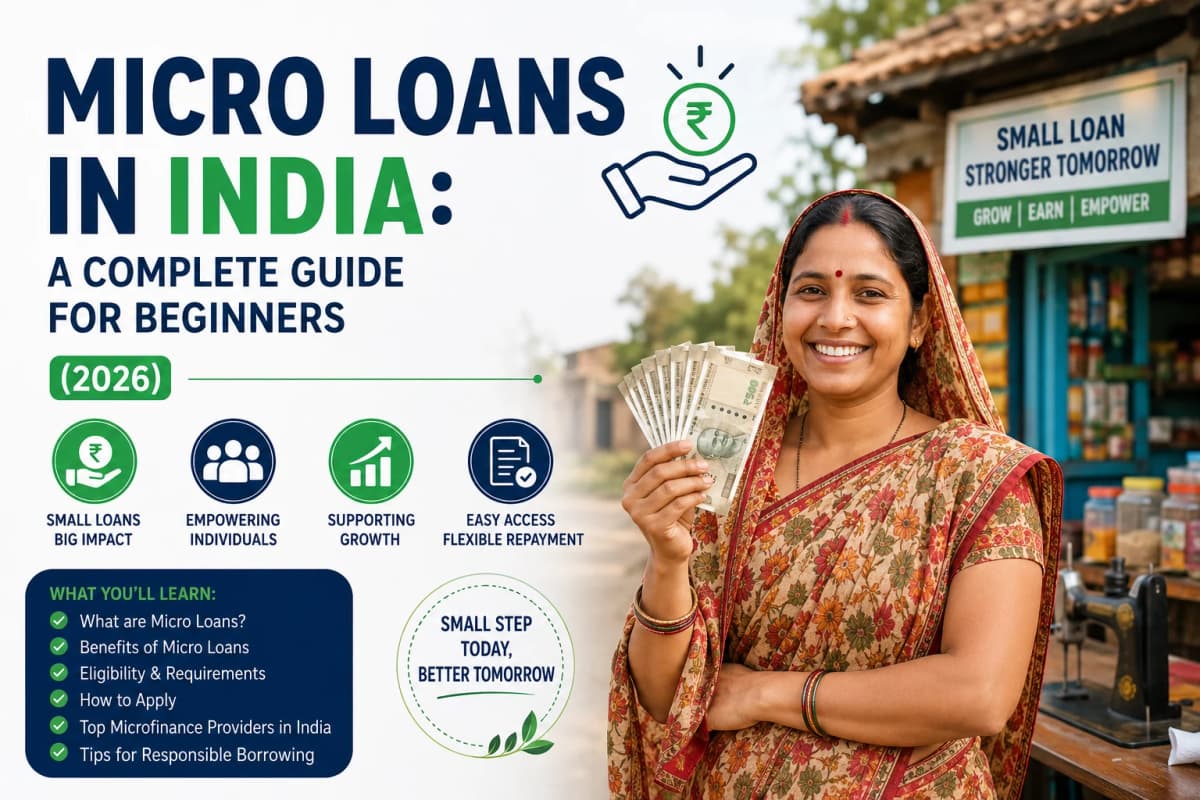
What is a micro loan in India? A micro loan in India is a small-value credit facility provided to low-income individuals or small business owners who lack access to traditional banking. These loans typically range from 10,000 to 1,00,000 INR and are offered by Microfinance Institutions (MFIs) or NBFCs to promote financial inclusion and self-employment.
How do micro loans help small businesses? Micro loans provide essential working capital for street vendors, artisans, and rural entrepreneurs. By offering funds without requiring heavy collateral, these loans allow small-scale business owners to purchase inventory, upgrade equipment, or manage daily expenses, ultimately helping them break the cycle of poverty through sustainable income.
Who is eligible for a micro loan in India? Eligibility for a micro loan in India generally includes Indian residents aged 18 to 60 with a low annual household income. While a high credit score isn't always mandatory, applicants must show a stable intent to use the funds for income-generating activities or personal emergencies.
Introduction to the Micro Loan Landscape in India
The financial heartbeat of India often pulses in its smallest villages and busiest street markets. For many, a micro loan India represents more than just money; it is a bridge to a better life.
Microfinance was designed to serve the "unbanked"—people who cannot get a standard bank loan because they lack collateral or a formal credit history. In India, this sector has grown into a massive ecosystem supporting millions of families.
In this guide, we will explore how these small loans work, why they are vital for the economy, and how you can safely apply for one to grow your business or manage your needs.
Understanding the Concept of Microfinance
Microfinance is a category of financial services which includes micro loans, savings, and insurance. It focuses on empowering individuals at the grassroots level.
Unlike a home loan or a car loan, a micro loan India involves smaller amounts and shorter repayment periods. The goal is to provide "seed capital" for tiny ventures that eventually grow into stable businesses.
Many microfinance programs in India also focus on women’s empowerment. By providing credit to female entrepreneurs, these loans help improve the living standards of entire households.
Why Choose a Micro Loan in India?
There are several reasons why someone might choose a micro loan over a traditional bank loan.
1. No Collateral Required
Most micro loans are "unsecured." This means you do not have to pledge your house, gold, or land as security to get the money.
2. Simple Documentation
Traditional banks often ask for years of tax returns. A micro loan India provider usually only asks for basic KYC documents like your Aadhaar card and PAN card.
3. Fast Processing
Since these loans are smaller, the approval process is much quicker. Some digital lenders can even provide funds within 24 to 48 hours.
4. Financial Inclusion
Micro loans reach deep into rural areas where big bank branches might not exist. They help bring people into the formal financial system.
Types of Micro Loans Available
In India, you can find different types of small-scale credit depending on your specific needs.
MUDRA Loans (PMMY)
The Pradhan Mantri Mudra Yojana (PMMY) is a government initiative. It offers three categories: Shishu (up to 50,000), Kishore (up to 5 lakh), and Tarun (up to 10 lakh).
Peer-to-Peer (P2P) Lending
Digital platforms now connect individual lenders directly with borrowers. This is a modern way to get a micro loan India using smartphone apps.
Self-Help Groups (SHGs)
In many villages, groups of people save money together. They then take a collective loan from a bank to distribute among members.
Joint Liability Groups (JLGs)
This involves a small group of 4-10 people who come together to apply for a loan. They are all responsible for ensuring that every member pays back their share.
Key Players: Who Provides These Loans?
The market for a micro loan India is diverse. It includes various types of institutions regulated by the Reserve Bank of India (RBI).
Microfinance Institutions (MFIs): Specialized companies that only handle small loans.
NBFCs (Non-Banking Financial Companies): Private companies that provide banking services without a full bank license.
Small Finance Banks (SFBs): Banks like Equitas or Ujjivan that focus specifically on small borrowers.
Regional Rural Banks (RRBs): Government-backed banks that serve the farming and rural community.
Eligibility Criteria for Borrowers
While every lender has its own rules, common requirements for a micro loan India include:
Age: Usually between 18 and 65 years old.
Residency: Must be a resident of India with a valid address proof.
Income Level: Total household income must fall within the limits set by the RBI (often under 3 lakh per year for microfinance).
Identity Proof: Aadhaar Card is the most important document.
Bank Account: You must have a basic savings account for the money to be transferred.
The Application Process Step-by-Step
Getting a micro loan India is much easier today than it was ten years ago.
Step 1: Identify Your Need
Decide exactly how much money you need. Do not borrow more than you can comfortably repay every month.
Step 2: Choose a Lender
Research MFIs or banks in your area. Look for those with good reputations and fair interest rates.
Step 3: Document Submission
Submit your Aadhaar, PAN, and a passport-sized photo. Some lenders may ask for a bank statement or a shop license if you have a business.
Step 4: Verification
The lender will verify your details. In rural areas, a field officer might visit your home or shop to check your business activity.
Step 5: Disbursement
Once approved, the money is sent directly to your bank account. You will receive a repayment schedule showing your monthly installments.
Interest Rates and Hidden Charges
It is important to be honest about the cost. A micro loan India often has a higher interest rate than a standard home loan.
This is because it costs the lender more money to manage many small loans than one large loan. However, the RBI caps these rates to prevent overcharging.
Always ask about "processing fees" or "insurance charges." Ensure you understand the "Reducing Balance" versus "Flat Rate" interest methods before signing.
The Role of Technology in Micro Lending
India has seen a digital revolution. Now, you can apply for a micro loan India using just a mobile phone.
Apps use "Alternative Data" to check if you are a good borrower. They might look at your utility bill payments or your mobile recharge history instead of just a CIBIL score.
This makes it possible for a small tailor or a delivery driver to get credit within minutes, which was impossible in the past.
Common Challenges and How to Avoid Them
While micro loans are helpful, they come with risks if not managed properly.
Over-Indebtedness
Borrowing from three or four different lenders at once is a bad idea. It can lead to a "debt trap" where you take a new loan just to pay off an old one.
High-Interest Scams
Be careful of "unregulated" lenders or moneylenders who charge daily interest. Only borrow from RBI-regulated entities.
Late Payment Penalties
Always pay your installments on time. Even a small delay can hurt your credit score, making it hard to get a larger loan in the future.
Impact of Micro Loans on the Indian Economy
The micro loan India sector contributes significantly to the national GDP. It supports the "Atmanirbhar Bharat" (Self-Reliant India) mission.
By funding millions of tiny businesses, microfinance creates jobs. It allows a weaver in Assam or a tea-stall owner in Kerala to expand their reach.
Moreover, it encourages the habit of regular savings and financial discipline among the lower-income segments of society.
Conclusion: A Step Toward Financial Freedom
A micro loan India is a powerful tool for growth. It levels the playing field for those who have the talent and hard work but lack the capital.
Whether you are starting a small grocery store or need funds for your child's education, these loans provide a safe and regulated way to get financial help.
Always remember to borrow responsibly, read the terms carefully, and use the funds to build a better future. Financial independence starts with a single, well-managed step.
Frequently Asked Questions (FAQs)
1. Can I get a micro loan if I have no credit score?
Yes, many microfinance institutions in India specialize in lending to first-time borrowers. They look at your business potential and character rather than just a CIBIL report. Over time, paying back this loan will actually help you build a good credit score.
2. What is the maximum amount I can borrow in a micro loan?
Typically, a micro loan India starts as low as 5,000 and can go up to 1,00,000 or 2,00,000 depending on the lender. For larger amounts for business, you might look into the Kishore or Tarun categories of the MUDRA scheme.
3. How long does it take to get the money?
If you apply through a digital platform or a modern NBFC, you can often get the money within 24 to 48 hours. Traditional group-based lending in villages might take 1 to 2 weeks because it involves group formation and training.
4. Do I need a guarantor for a micro loan?
In many cases, yes. While you don't need physical collateral (like land), many lenders use the "Group Guarantee" model. This means your neighbors or fellow group members stand as a guarantee for your honest repayment.
5. Can I use a micro loan for personal reasons like a medical emergency?
While most micro loans are intended for income-generating activities (business), many lenders also offer "Consumer" or "Emergency" micro loans for health, education, or home repairs. Always check with the lender about the "purpose of the loan" they allow.
6. What happens if I cannot pay back the loan on time?
If you miss a payment, the lender will charge a late fee, and your credit score will drop. It is always best to talk to your loan officer immediately if you face a genuine problem. They may be able to offer a short extension or a different repayment plan.