Deciding to purchase a house is one of the biggest financial choices you will ever make. Once you select the perfect property, the next big hurdle is choosing how to finance it.
When you apply for housing finance in India, banks will ask you a critical question. Do you want a fixed interest rate or a floating interest rate? This single decision will dictate how much money you pay back over the next 15 to 30 years.
In this guide, we will break down the fixed vs floating interest rate home loan current market india landscape. We will explain how the two options work, analyze the current 2026 market trends driven by the Reserve Bank of India (RBI), and help you choose the best fit for your budget.
Direct Answer Snippets for Quick Understanding
What is the difference between fixed and floating home loan rates in India?
In the fixed vs floating interest rate home loan current market india system, a fixed rate stays constant for a set period, providing complete EMI predictability. A floating rate changes periodically because it links directly to external market benchmarks like the RBI repo rate, causing your EMIs or loan tenure to fluctuate over time.
Which interest rate option is better in the current Indian market?
For most home buyers in the current market, a floating interest rate is highly preferred. The RBI has maintained a stable repo rate of 5.25%, creating a favorable environment for variable loans. Floating loans also offer much lower starting interest rates compared to rigid fixed-rate options.
Are there any prepayment penalties for these loan types?
According to mandatory RBI guidelines, Indian banks cannot charge any prepayment or foreclosure penalties on floating interest rate home loans for individual borrowers. However, if you choose a fixed interest rate home loan, lenders can legally charge a prepayment fee if you pay off the loan early.
Understanding Fixed Interest Rate Home Loans
A fixed interest rate home loan is simple to understand. When you sign the loan contract, the bank locks in a specific interest percentage that remains unchanged.
The primary benefit of this system is total financial predictability. Because your interest rate is locked, your monthly Equated Monthly Installment (EMI) remains exactly the same from the first month to the very last month of your tenure.
This setup is ideal for individuals who live on a strict, unchanging monthly salary. It allows you to plan your long-term household household budgets without worrying about global economic shifts or central bank policy updates.
The Catch with Fixed Rate Loans in India
While complete safety sounds wonderful, fixed-rate loans come with significant downsides in the Indian financial market.
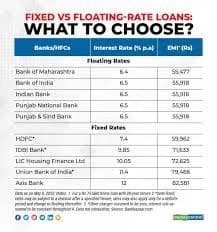
First, banks charge a premium for the peace of mind they offer. A fixed-rate loan typically carries a starting interest rate that is 1% to 2.5% higher than a comparable floating loan. This means your initial monthly outgoings will be much higher.
Second, most Indian banks do not offer a truly fixed rate for a 20-year or 30-year tenure anymore. Instead, they offer hybrid structures. These loans stay fixed for the first 2 to 5 years and then automatically convert into standard floating rate accounts.
Understanding Floating Interest Rate Home Loans
A floating interest rate home loan operates on a dynamic pricing model. The interest rate on your loan is tied directly to an external benchmark set by the broader market.
In India, most banks link their floating products to the External Benchmark Lending Rate (EBLR) or the Repo Linked Lending Rate (RLLR). This means whenever the Reserve Bank of India alters its primary lending rates, your home loan rate reacts almost instantly.
When the macroeconomy slows down and the central bank reduces rates to encourage growth, your floating rate drops automatically. This translates to lower monthly EMIs or a shorter overall loan tenure without any hectic refinancing paperwork.
Analyzing the Current Market Dynamics in India
To make an intelligent choice regarding a fixed vs floating interest rate home loan current market india, you must look at the real-world economic environment.
The Reserve Bank of India’s Monetary Policy Committee has held the benchmark repo rate steady at 5.25%. This policy creates a highly reliable and balanced lending environment across the nation.
Because inflation is under control and the rate hike cycle has cooled down, floating-rate borrowers are experiencing stable, manageable EMIs. Starting floating home loan rates from top public sector and private banks are highly competitive, ranging from roughly 7.10% to 9.50% depending on individual credit scores.
Comparing Head-to-Head: Fixed vs Floating
Let us compare the two options across essential operational categories to see how they impact your wallet.
Starting Cost Barrier
Floating rate loans easily win the initial cost battle. Since banks do not have to protect themselves from long-term market inflation risks, they offer their lowest baseline interest rates on floating products, saving you money from day one.
Prepayment Freedom
This is a massive factor for long-term savings. The RBI strictly prohibits banks from levying prepayment penalties on individual floating loans. You can dump lump-sum bonuses or extra savings into your floating loan to clear your principal early for zero extra cost. Fixed loans do not enjoy this legal luxury.
Budget Peace of Mind
If the thought of your monthly home loan expense changing by a few thousand rupees due to global market events gives you immense stress, the fixed-rate loan wins. It isolates your household wallet from external economic volatility completely.
How to Choose the Right Path for Your Home Journey
Selecting the ultimate loan structure depends heavily on your personal financial health, career stability, and individual risk tolerance.
Consider opting for a floating rate loan if you are looking at a traditional long-term tenure of 15 to 30 years. Over such an extended period, the Indian economy will experience multiple rate cycles, and a floating structure generally proves more cost-effective as rates balance out over time.
On the other hand, a fixed interest rate might serve you well if you are taking a very short loan of 3 to 5 years, or if you are self-employed with seasonal cash flows and desperately require strict, unaltering expenditure targets to keep your business books clean.
Conclusion
Weighing the choices of a fixed vs floating interest rate home loan current market india is all about balancing upfront savings against future certainty. With the RBI repo rate comfortably resting at 5.25%, the current macroeconomic climate heavily favors floating interest rates. They offer lower initial costs and the legal freedom to make penalty-free prepayments whenever you have extra cash. Ensure you check your CIBIL score to lock in the lowest possible bank spread, read the reset clauses in your contract carefully, and choose the loan type that keeps your monthly housing budget safe and sustainable.
Genuine Frequently Asked Questions (FAQs)
1. Can I switch from a fixed interest rate to a floating interest rate later on?
Yes, most Indian banks and housing finance companies allow you to switch your loan structure from fixed to floating or vice versa. However, this transition is not free. Lenders will charge a nominal conversion or processing fee, which usually ranges from 0.25% to 0.50% of your outstanding loan balance.
2. How often do floating interest rates change in India?
Floating interest rates linked to external benchmarks like the RBI repo rate are legally required to be reset by the bank at least once every three months. If the RBI changes the repo rate, your bank will adjust your applicable interest rate within this three-month window.
3. When a floating interest rate rises, does my monthly EMI amount increase instantly?
To save borrowers from sudden monthly cash shocks, banks usually do not increase your immediate EMI amount when floating rates rise. Instead, they extend your total loan tenure. Your monthly payment stays the same, but you will have to pay it for a few extra months or years to cover the cost.
4. Why are fixed interest rates always higher than floating interest rates?
Fixed rates are always higher because the bank takes on all the future market risk. If global inflation causes interest rates across India to skyrocket to 12%, the bank cannot increase your locked rate. To protect themselves from this potential loss, they build a safety premium into your starting fixed rate.
5. What is a hybrid or semi-fixed home loan?
A hybrid home loan is a combination product. It offers a fixed interest rate for an initial introductory period, usually the first 2, 3, or 5 years of the tenure. Once this promotional introductory time block expires, the entire loan automatically transitions into a standard floating rate loan for the remaining duration.
6. Does my CIBIL score affect both fixed and floating interest rates?
Yes, your credit score plays a massive role in both options. Even if you choose a floating loan, the bank adds a personal risk margin called a "spread" on top of the base benchmark. A high CIBIL score above 750 ensures the bank keeps this spread low, securing you the absolute cheapest rate available in the market.