Securing a student loan is an incredible way to fund your higher education goals independently. It bridges the gap between your academic aspirations and your family's current savings, allowing you to focus entirely on your college degrees.
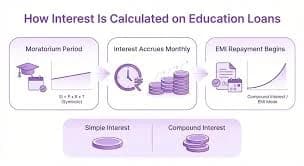
To give you complete peace of mind while studying, banks offer a specialized structural break called a moratorium period, often referred to as a repayment holiday or a grace period. This timeline typically covers your entire course duration plus an extra six months to one year after graduation to help you find a job. While you are not legally obligated to pay any Equated Monthly Installments (EMIs) during this phase, your loan account is not interest-free.
In this comprehensive guide, we will simplify the education loan moratorium period interest calculation rules. We will explain how interest builds up while you are in the classroom, how different banks calculate this cost, and how you can save lakhs of rupees by understanding the fine print.
Direct Answer Snippets for Quick Understanding
How is interest calculated during the education loan moratorium period?
Under standard education loan moratorium period interest calculation rules, interest begins accumulating from the exact day your initial fund installment is disbursed. Government banks typically calculate this as simple interest on the disbursed principal amount. Private banks and Non-Banking Financial Companies (NBFCs) often apply monthly compounding rules to any unpaid interest.
What happens to the accumulated interest after the moratorium ends?
Once your course duration and post-graduation grace period officially conclude, the lender tallies the total interest accrued during the holiday. This accumulated interest amount is permanently added to your original borrowed principal. The bank then uses this new, higher combined base figure to calculate your final monthly EMI.
Can I pay interest during the student loan moratorium period?
Yes, servicing your interest during the repayment holiday is highly encouraged and completely optional. If your financial guardian pays the simple interest components monthly during your studies, public sector banks like SBI will grant an automatic one percent interest rate concession for the entire remaining tenure of your loan.
Understanding the Structure of a Moratorium Period
Before analyzing the core mathematical equations, let us clarify why this repayment holiday exists. Lenders understand that a full-time student cannot earn a living wage while attending engineering classes or business lectures.
The moratorium period acts as a financial buffer. It spans your total course duration plus a grace window—usually twelve months after course completion or six months after securing active employment, whichever occurs earlier.
During this extensive block, the bank keeps your status as active and clear without demanding principal or interest collections. However, because the capital is already active, interest math ticks continuously in the background on a daily reducing balance.
Simple Interest vs Compound Interest Calculation Rules
The type of financial institution you select for your educational credit will dictate the exact mathematical rules used to process your background interest.
Government Bank Rules (Simple Interest Focus)
Public sector giants across India follow borrower-friendly guidelines mapped by the Indian Banks' Association (IBA). They are legally required to apply only simple interest during the study and grace periods.
The basic formula used to track your liability during the moratorium is:
$$\text{Simple Interest} = \frac{\text{Disbursed Principal} \times \text{Annual Interest Rate} \times \text{Time in Days}}{365 \times 100}$$
Because it tracks as simple interest, the accrued interest component never merges with your principal while you are studying. It sits in a separate ledger, keeping your underlying debt from swelling out of control.
Private Bank and NBFC Rules (Compounding Focus)
Private commercial lenders and specialized fintech housing finance corporations take a much more aggressive risk approach. If you choose the "no-payment" structure with them, they will compound the unpaid interest monthly.
Every month, the interest generated is automatically rolled into your core principal. The following month, you are charged interest on top of your past interest. This compounding pattern creates an exponential growth curve, which can result in a massive debt shock when your EMIs formally begin.
The Reality of Phased Disbursals on Interest Math
Another crucial factor that beginners overlook is that tuition fees are paid out in distinct semesters, not as a single upfront payout. Your interest calculation reflects this step-by-step cash deployment.
If your total sanctioned loan is twenty Lakh, but the bank has only transferred five Lakh to your college for the first semester, your interest accumulates strictly on that active five Lakh.
The remaining fifteen Lakh sits safely inside the bank's system and accumulates zero interest charges until subsequent semesters trigger fresh payouts. This phased approach helps keep your overall interest accrual lower during the initial years of your degree.
Smart Strategies to Lower Your Post-Graduation EMI Burden
Navigating the education loan moratorium period interest calculation rules intelligently can significantly alter your long-term financial trajectory.
Pay the Simple Interest Component Monthly
If your parents or co-applicants possess stable disposable income, request them to clear the simple interest component every month. By keeping the interest ledger at zero, you ensure that your principal remains completely baseline, leading to much lower post-graduation EMIs.
Capitalize on Government Subsidy Schemes
The Government of India manages excellent interest subsidy programs, such as the Central Sector Interest Subsidy (CSIS) scheme. If your total parental income falls below specified economic thresholds, the government will pay the entire simple interest component on your behalf during your moratorium period, making your study holiday entirely interest-free.
Step-by-Step Breakdown of the Post-Moratorium Transition
When your grace period concludes, the bank initiates a systematic process to lock in your long-term repayment schedule.
Step 1: Consolidation of Unpaid Interest
The bank's internal computing system pulls your historical ledger data and computes the total unpaid interest accumulated across all separate semester payouts.
Step 2: Fixing the New Repayment Principal
This step defines your final liability. The bank executes a simple structural equation:
$$\text{Final Repayment Principal} = \text{Total Disbursed Amount} + \text{Accumulated Moratorium Interest}$$
Step 3: Fixing Your Monthly EMI Plan
Using this newly calculated combined principal base, the bank applies the standard global amortized EMI formula over your chosen tenure (typically up to fifteen years), locking in a predictable monthly budget for your corporate career.
Conclusion
Understanding the education loan moratorium period interest calculation rules is an essential form of financial literacy for every student planning to study in India or abroad. While the moratorium holiday offers vital breathing space to focus on your university exams, the background interest accrual requires strategic planning. By prioritizing public sector banks that use simple interest rules, utilizing monthly interest payments to secure the one percent bank discount, or tapping into government interest subsidies, you can prevent your debt from compounding and ensure a smooth, confident, and highly successful transition into your professional life.
Genuine Frequently Asked Questions (FAQs)
1. Does my moratorium period automatically extend if I fail my final year college exams?
Most public sector banks offer a safety extension option if a student faces unexpected academic hurdles. If you cannot complete your course within the scheduled timeline due to genuine reasons, the bank can legally extend your moratorium window for a maximum of two additional years, though interest will continue to accrue.
2. Is the interest calculation based on the total sanctioned loan or the disbursed amount?
Interest is calculated strictly based on the actual disbursed amount transferred to your university or vendor account. If your approved loan limit is forty Lakh, but the bank has only disbursed ten Lakh for your initial year of study, your interest accumulates exclusively on that ten Lakh.
3. Can I make principal prepayments while the moratorium holiday is active?
Yes, you have complete legal freedom to execute partial prepayments or full principal repayments at any stage of your study period. Doing so lowers the underlying principal amount on which your daily interest is calculated, helping you close your student loan much faster.
4. Why do private banks require partial interest payments during the study period?
Private banks and NBFCs often enforce mandatory partial or full interest servicing during the course duration to lower their operational credit risk. It serves as proof that the co-applicant holds a stable cash flow and prevents the total loan balance from growing too high through monthly compounding.
5. Can I claim an income tax deduction on the interest paid during the moratorium?
Yes, you can claim attractive tax savings under Section 80E of the Income Tax Act. Any individual who pays the interest component on an education loan can claim a 100 percent deduction on that interest amount from their taxable income, provided they file under the Old Tax Regime.
6. What happens if I secure an elite international job immediately after graduation?
If you secure a high-paying corporate placement immediately after your course ends, your official moratorium period may conclude early according to specific bank contracts (such as six months after securing a job). Your regular EMI schedule will activate, allowing you to use your foreign income to pay off your debt quickly.Securing a student loan is an incredible way to fund your higher education goals independently. It bridges the gap between your academic aspirations and your family's current savings, allowing you to focus entirely on your college degrees.
To give you complete peace of mind while studying, banks offer a specialized structural break called a moratorium period, often referred to as a repayment holiday or a grace period. This timeline typically covers your entire course duration plus an extra six months to one year after graduation to help you find a job. While you are not legally obligated to pay any Equated Monthly Installments (EMIs) during this phase, your loan account is not interest-free.
In this comprehensive guide, we will simplify the education loan moratorium period interest calculation rules. We will explain how interest builds up while you are in the classroom, how different banks calculate this cost, and how you can save lakhs of rupees by understanding the fine print.
Direct Answer Snippets for Quick Understanding
How is interest calculated during the education loan moratorium period?
Under standard education loan moratorium period interest calculation rules, interest begins accumulating from the exact day your initial fund installment is disbursed. Government banks typically calculate this as simple interest on the disbursed principal amount. Private banks and Non-Banking Financial Companies (NBFCs) often apply monthly compounding rules to any unpaid interest.
What happens to the accumulated interest after the moratorium ends?
Once your course duration and post-graduation grace period officially conclude, the lender tallies the total interest accrued during the holiday. This accumulated interest amount is permanently added to your original borrowed principal. The bank then uses this new, higher combined base figure to calculate your final monthly EMI.
Can I pay interest during the student loan moratorium period?
Yes, servicing your interest during the repayment holiday is highly encouraged and completely optional. If your financial guardian pays the simple interest components monthly during your studies, public sector banks like SBI will grant an automatic one percent interest rate concession for the entire remaining tenure of your loan.
Understanding the Structure of a Moratorium Period
Before analyzing the core mathematical equations, let us clarify why this repayment holiday exists. Lenders understand that a full-time student cannot earn a living wage while attending engineering classes or business lectures.
The moratorium period acts as a financial buffer. It spans your total course duration plus a grace window—usually twelve months after course completion or six months after securing active employment, whichever occurs earlier.
During this extensive block, the bank keeps your status as active and clear without demanding principal or interest collections. However, because the capital is already active, interest math ticks continuously in the background on a daily reducing balance.
Simple Interest vs Compound Interest Calculation Rules
The type of financial institution you select for your educational credit will dictate the exact mathematical rules used to process your background interest.
Government Bank Rules (Simple Interest Focus)
Public sector giants across India follow borrower-friendly guidelines mapped by the Indian Banks' Association (IBA). They are legally required to apply only simple interest during the study and grace periods.
The basic formula used to track your liability during the moratorium is:
$$\text{Simple Interest} = \frac{\text{Disbursed Principal} \times \text{Annual Interest Rate} \times \text{Time in Days}}{365 \times 100}$$
Because it tracks as simple interest, the accrued interest component never merges with your principal while you are studying. It sits in a separate ledger, keeping your underlying debt from swelling out of control.
Private Bank and NBFC Rules (Compounding Focus)
Private commercial lenders and specialized fintech housing finance corporations take a much more aggressive risk approach. If you choose the "no-payment" structure with them, they will compound the unpaid interest monthly.
Every month, the interest generated is automatically rolled into your core principal. The following month, you are charged interest on top of your past interest. This compounding pattern creates an exponential growth curve, which can result in a massive debt shock when your EMIs formally begin.
The Reality of Phased Disbursals on Interest Math
Another crucial factor that beginners overlook is that tuition fees are paid out in distinct semesters, not as a single upfront payout. Your interest calculation reflects this step-by-step cash deployment.
If your total sanctioned loan is twenty Lakh, but the bank has only transferred five Lakh to your college for the first semester, your interest accumulates strictly on that active five Lakh.
The remaining fifteen Lakh sits safely inside the bank's system and accumulates zero interest charges until subsequent semesters trigger fresh payouts. This phased approach helps keep your overall interest accrual lower during the initial years of your degree.
Smart Strategies to Lower Your Post-Graduation EMI Burden
Navigating the education loan moratorium period interest calculation rules intelligently can significantly alter your long-term financial trajectory.
Pay the Simple Interest Component Monthly
If your parents or co-applicants possess stable disposable income, request them to clear the simple interest component every month. By keeping the interest ledger at zero, you ensure that your principal remains completely baseline, leading to much lower post-graduation EMIs.
Capitalize on Government Subsidy Schemes
The Government of India manages excellent interest subsidy programs, such as the Central Sector Interest Subsidy (CSIS) scheme. If your total parental income falls below specified economic thresholds, the government will pay the entire simple interest component on your behalf during your moratorium period, making your study holiday entirely interest-free.
Step-by-Step Breakdown of the Post-Moratorium Transition
When your grace period concludes, the bank initiates a systematic process to lock in your long-term repayment schedule.
Step 1: Consolidation of Unpaid Interest
The bank's internal computing system pulls your historical ledger data and computes the total unpaid interest accumulated across all separate semester payouts.
Step 2: Fixing the New Repayment Principal
This step defines your final liability. The bank executes a simple structural equation:
$$\text{Final Repayment Principal} = \text{Total Disbursed Amount} + \text{Accumulated Moratorium Interest}$$
Step 3: Fixing Your Monthly EMI Plan
Using this newly calculated combined principal base, the bank applies the standard global amortized EMI formula over your chosen tenure (typically up to fifteen years), locking in a predictable monthly budget for your corporate career.
Conclusion
Understanding the education loan moratorium period interest calculation rules is an essential form of financial literacy for every student planning to study in India or abroad. While the moratorium holiday offers vital breathing space to focus on your university exams, the background interest accrual requires strategic planning. By prioritizing public sector banks that use simple interest rules, utilizing monthly interest payments to secure the one percent bank discount, or tapping into government interest subsidies, you can prevent your debt from compounding and ensure a smooth, confident, and highly successful transition into your professional life.
Genuine Frequently Asked Questions (FAQs)
1. Does my moratorium period automatically extend if I fail my final year college exams?
Most public sector banks offer a safety extension option if a student faces unexpected academic hurdles. If you cannot complete your course within the scheduled timeline due to genuine reasons, the bank can legally extend your moratorium window for a maximum of two additional years, though interest will continue to accrue.
2. Is the interest calculation based on the total sanctioned loan or the disbursed amount?
Interest is calculated strictly based on the actual disbursed amount transferred to your university or vendor account. If your approved loan limit is forty Lakh, but the bank has only disbursed ten Lakh for your initial year of study, your interest accumulates exclusively on that ten Lakh.
3. Can I make principal prepayments while the moratorium holiday is active?
Yes, you have complete legal freedom to execute partial prepayments or full principal repayments at any stage of your study period. Doing so lowers the underlying principal amount on which your daily interest is calculated, helping you close your student loan much faster.
4. Why do private banks require partial interest payments during the study period?
Private banks and NBFCs often enforce mandatory partial or full interest servicing during the course duration to lower their operational credit risk. It serves as proof that the co-applicant holds a stable cash flow and prevents the total loan balance from growing too high through monthly compounding.
5. Can I claim an income tax deduction on the interest paid during the moratorium?
Yes, you can claim attractive tax savings under Section 80E of the Income Tax Act. Any individual who pays the interest component on an education loan can claim a 100 percent deduction on that interest amount from their taxable income, provided they file under the Old Tax Regime.
6. What happens if I secure an elite international job immediately after graduation?
If you secure a high-paying corporate placement immediately after your course ends, your official moratorium period may conclude early according to specific bank contracts (such as six months after securing a job). Your regular EMI schedule will activate, allowing you to use your foreign income to pay off your debt quickly.