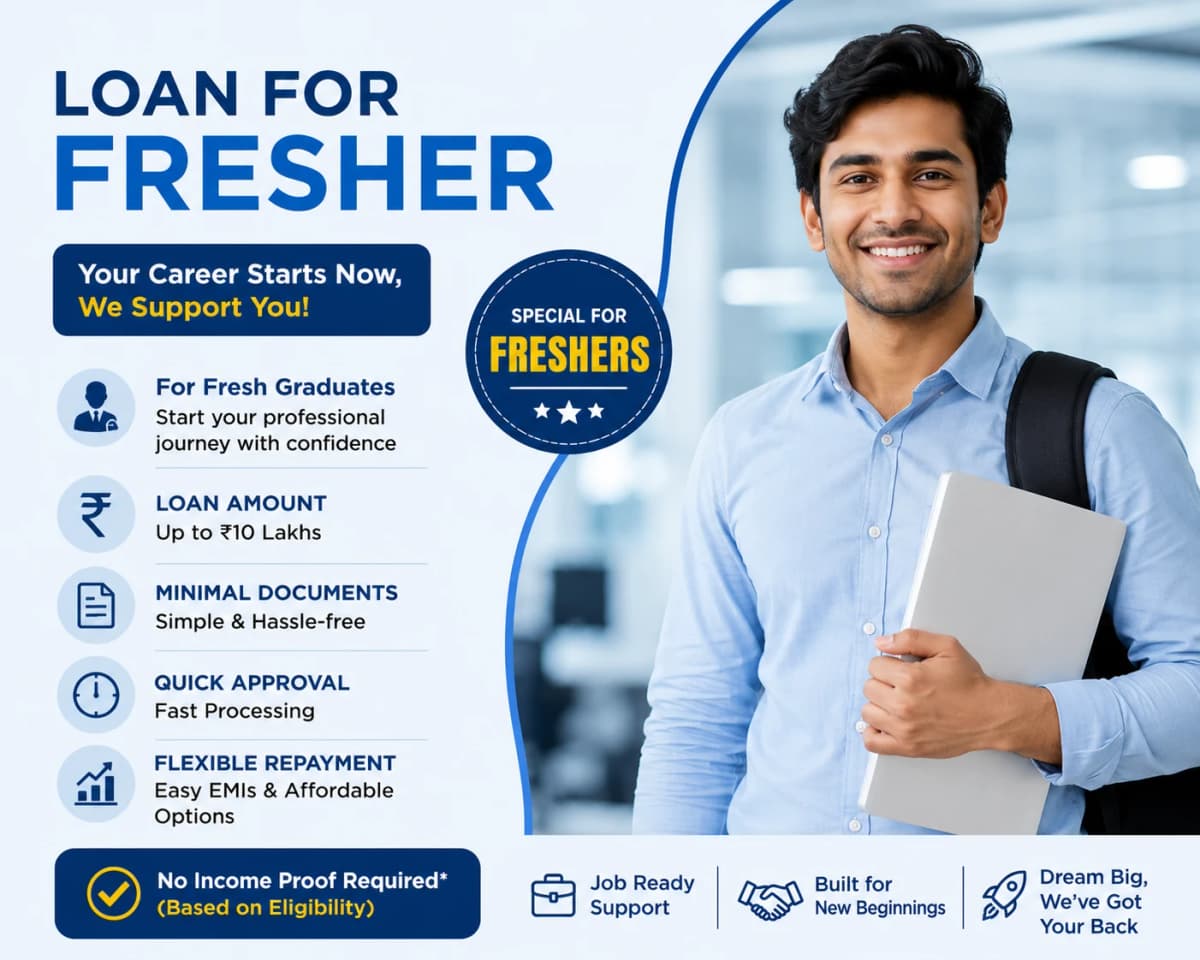
Can a fresher get a personal loan?
Yes, a fresher can get a personal loan even without a long work history or a CIBIL score. Many fintech lenders and some private banks offer "New-to-Credit" loans. They evaluate your profile based on your salary, the reputation of your employer, and your educational background rather than just a credit report.
How much loan can a fresher get?
Most lenders offer freshers loans ranging from 50,000 to 5,00,000 depending on their monthly take-home salary. Usually, the loan amount is capped so that the monthly EMI does not exceed 40% to 50% of your net income, ensuring you can manage repayments comfortably.
What is the minimum salary for a fresher loan?
To qualify for a personal loan for freshers, most lenders require a minimum monthly net salary of 15,000 to 25,000. This requirement varies depending on whether you live in a metropolitan city or a smaller town, and whether you work for a Tier-1 or Tier-2 company.
Understanding the Loan for Fresher Concept
As a fresher, you are a "New-to-Credit" (NTC) customer. This means you likely don’t have a credit score yet because you’ve never had a credit card or a previous loan.
Traditionally, banks relied heavily on the CIBIL score to judge reliability. However, the market has changed. Lenders now use "Alternative Data" to assess your creditworthiness.
Why Lenders are Interested in Freshers
Freshers represent the future. You have a long career ahead of you and a growing income potential. Lenders want to build a relationship with you early on.
If you handle your first loan for fresher responsibly, you become a loyal customer for future products like car loans or home loans.
Eligibility Criteria for First-Time Borrowers
Before you apply, you need to meet certain basic requirements. While every bank has its own internal policy, the following are standard:
1. Age Requirement
Most lenders require you to be at least 21 years old. Some fintech apps may allow applications starting from age 18 if you have a stable income.
2. Employment Status
You must be a salaried employee. Most banks require you to have been in your current job for at least 3 to 6 months to prove stability.
3. Minimum Income
Your salary is the biggest factor. A higher salary usually leads to better interest rates and a higher loan amount.
4. Company Category
Lenders often categorize employers into "Elite," "Super A," or "B." If you work for a well-known MNC or a top-tier startup, your chances of approval are much higher.
Documents Needed for a Loan for Fresher
Keeping your documents ready can speed up the "instant loan" process. Since most applications are digital, you will need scanned copies of:
Identity Proof: PAN Card (Mandatory) and Aadhaar Card.
Address Proof: Voter ID, Passport, or Utility Bills.
Income Proof: Last 3 months' salary slips.
Bank Statements: Last 6 months' bank statements showing salary credits.
Employment Proof: Employee ID card or your official Offer Letter.
How to Improve Your Chances of Approval
If you are worried about rejection, follow these steps to strengthen your application for a loan for fresher:
Build a Relationship with Your Salary Bank
The bank where your salary is credited is the best place to start. They can see your monthly cash flow and are more likely to offer you a "pre-approved" loan.
Keep a Low Debt-to-Income Ratio
Don't apply for a loan that requires an EMI higher than half your salary. Lenders want to see that you have enough money left for your rent and groceries.
Check Your Employer's Reputation
If your company is registered and reputable, mention it clearly. Lenders feel safer giving a loan for fresher employees who work at stable organizations.
Interest Rates and Charges to Watch Out For
Loans for freshers often come with slightly higher interest rates because the lender is taking a "risk" on a person with no credit history.
Typical Interest Rates
You can expect interest rates to range from 11% to 24% per annum. Digital lending apps might charge higher rates but offer faster processing.
Processing Fees
Most banks charge a one-time fee of 1% to 3% of the loan amount. Always ask if this can be waived or reduced during festive seasons.
Prepayment Penalties
If you get a bonus and want to close your loan early, some banks charge a "foreclosure fee." Try to find a lender that allows fee-free part-payments.
Step-by-Step Guide to Apply for a Loan for Fresher
Research: Compare different lenders online. Look at interest rates and hidden charges.
Check Eligibility: Use online calculators to see how much you can borrow based on your salary.
Documentation: Gather your PAN, Aadhaar, and salary slips.
Application: Fill out the form on the bank's website or app.
Verification: The lender will verify your details and might call your office or visit your residence.
Disbursal: Once approved, the money is usually transferred to your bank account within 24 to 48 hours.
Common Pitfalls to Avoid
Getting your first loan for fresher is a big responsibility. Avoid these common mistakes:
Applying to Multiple Lenders: Every time you apply, it shows up as a "Hard Inquiry." Too many inquiries can lower your future credit score.
Ignoring the Fine Print: Read the terms and conditions regarding late payment fees and bounce charges.
Borrowing More Than Needed: Only take what you absolutely require. Remember, you have to pay interest on every penny.
Conclusion
Securing a loan for fresher is no longer the hurdle it used to be. With the rise of fintech and specialized banking products, your first paycheck can be the gateway to financial flexibility.
The key is to borrow responsibly. Use your first loan to build a strong CIBIL score, which will help you get cheaper loans for a home or a car later in life. Always prioritize your EMIs, stay within your budget, and choose a reputable lender.
Frequently Asked Questions (FAQs)
1. Can I get a loan if I just started my job yesterday?
Most lenders require at least one month's salary to be credited to your account before they process a loan. It is better to wait for 3 months to show employment stability.
2. Is a PAN card mandatory for a personal loan for freshers?
Yes, a PAN card is mandatory for all formal loans in India. It is used to track your financial history and link your future credit score.
3. Will taking a loan as a fresher ruin my credit score?
No, taking a loan and paying it back on time is the best way to build a high credit score. It only ruins your score if you miss payments or pay late.
4. Are there any collateral-free loans for freshers?
Yes, personal loans are "unsecured," meaning you do not have to provide any gold, property, or assets as security. Your salary is your security.
5. Can I use a co-applicant to get a higher loan amount?
Yes, if your salary is low, you can add a parent or a sibling with a good income and credit score as a co-applicant. This increases the chances of approval and a higher loan limit.
6. What happens if I miss an EMI on my first loan?
Missing an EMI will result in heavy late fees and will negatively impact your credit score. A poor start can make it very difficult to get any loans or credit cards for the next several years.