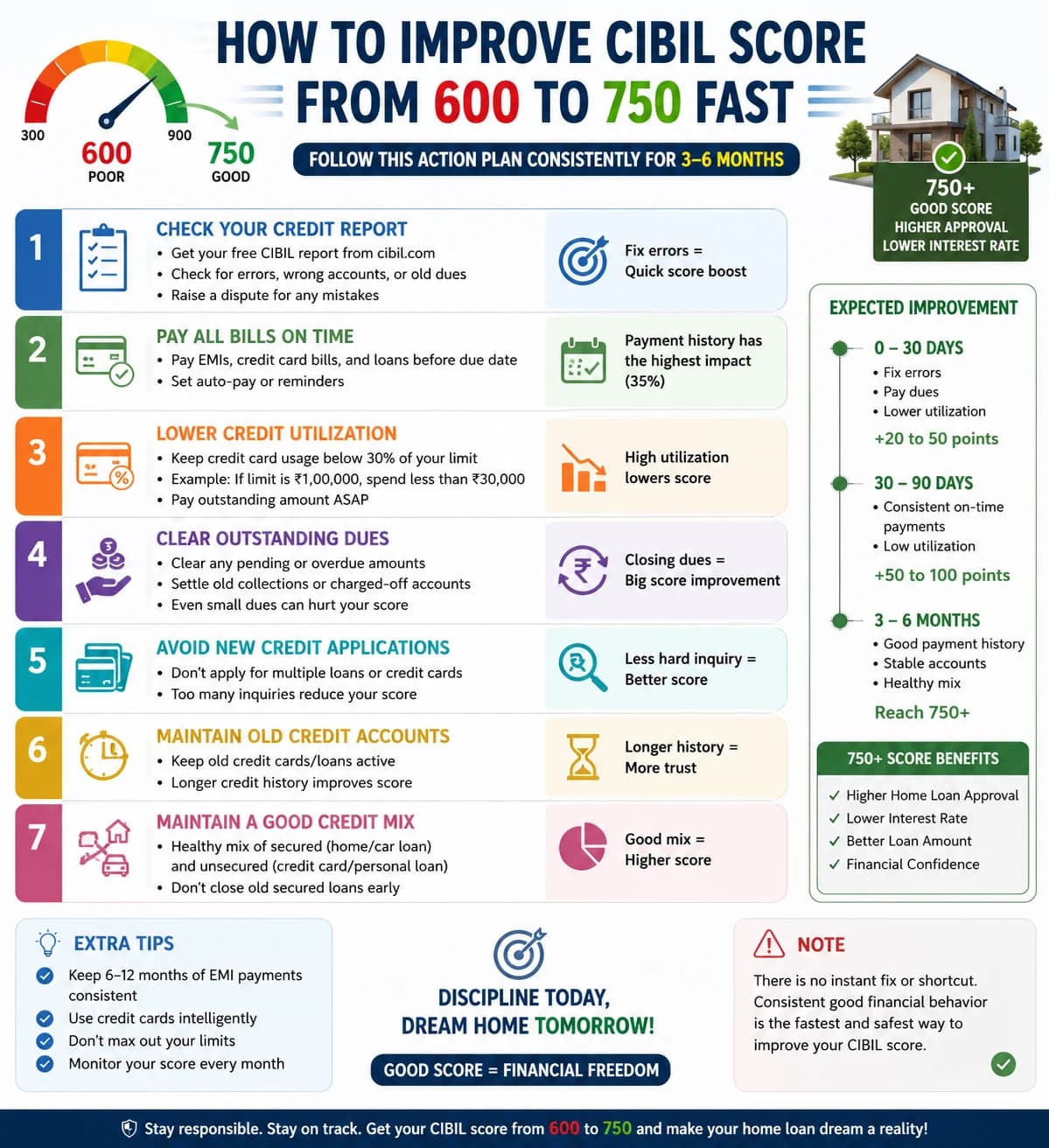
Many people dream of buying their own home, but a low credit score often stands in the way. If your current CIBIL score is around 600, you are likely facing challenges with loan approvals and higher interest rates.
The good news is that your credit score is not permanent. By adopting disciplined financial habits, you can work toward a score of 750 or higher. This guide explains how to fix your CIBIL score from 600 to 750 to ensure you meet home loan eligibility requirements.
What Is a CIBIL Score and Why Does It Matter?
Your CIBIL score is a three-digit summary of your credit history, ranging from 300 to 900. Banks and housing finance companies use this number to assess your risk level before approving a home loan.
A score of 750 is generally considered the "gold standard" by most lenders in India. Achieving this score helps you get faster approvals and, more importantly, access to lower interest rates, which can save you significant money over the long term.
3 Direct Answer Snippets
How long does it take to fix a CIBIL score? Improving a credit score is a gradual process that depends on your specific financial history. While there is no "instant" fix, consistent positive repayment behavior can lead to noticeable improvements within 6 to 12 months. Focus on timely payments and debt reduction to see steady growth.
Why is 750 the magic number for home loans? A CIBIL score of 750 or above signals to banks that you are a low-risk borrower who manages credit responsibly. This benchmark often qualifies applicants for the best available interest rates and speeds up the verification process, making your home loan journey smoother and more affordable.
Does checking my own credit score hurt it? No, checking your own CIBIL score is considered a "soft inquiry" and does not lower your points. However, applying for multiple loans or credit cards in a short period triggers "hard inquiries," which can negatively impact your score. Monitor your report regularly to ensure all information is accurate.
Core Factors That Influence Your Credit Score
Understanding the factors that shape your score is the first step toward fixing it. If you want to move from 600 to 750, you must focus on these primary areas:
Payment History
This is the most critical factor. Your history of paying EMIs and credit card bills on time accounts for a large portion of your score. Even a single missed payment can significantly damage your rating.
Credit Utilization Ratio
This is the percentage of your total available credit limit that you are currently using. If your limit is 1 lakh and you use 90,000, your utilization is high. Keeping this ratio below 30% is ideal for building your score.
Credit Mix
Lenders prefer to see a healthy mix of secured loans (like home or auto loans) and unsecured loans (like personal loans or credit cards). Relying only on unsecured debt can sometimes lower your score potential.
Steps to Fix CIBIL Score From 600 to 750
If you are ready to take control of your financial health, follow these steps to improve your creditworthiness.
1. Check Your Credit Report for Errors
Download your free CIBIL report and check it carefully. Sometimes, clerical errors like a loan you already closed still showing as "open" can hurt your score. Dispute any inaccuracies immediately with the credit bureau.
2. Prioritize Timely EMI Payments
Set up automatic reminders or standing instructions for all your loan and credit card payments. Being punctual is the fastest way to signal reliability to lenders. If you have any overdue payments, clear them as a top priority.
3. Lower Your Credit Card Balances
If you are consistently hitting your credit limit, try to pay down the balance. A high utilization ratio suggests financial stress. By paying off excess debt, you instantly improve your profile in the eyes of the credit scoring model.
4. Avoid Applying for New Credit
Every time you apply for a new loan or credit card, the lender performs a hard inquiry on your report. Multiple inquiries in a short span suggest you are credit-hungry, which drops your score. Pause all new applications until your score improves.
5. Keep Old Accounts Open
The age of your credit accounts matters. Even if you have paid off an old credit card, keep the account open if it has no annual fee. A longer credit history provides more data to lenders, which helps boost your score over time.
Maintaining Your Score for the Future
Once you reach your goal, do not stop your good habits. Financial discipline is a lifelong commitment. Continue to monitor your credit report at least once every six months to ensure there are no surprises.
Always borrow only what you can afford to repay. A home loan is a long-term commitment, and maintaining a high CIBIL score ensures that your financial path remains open for other future needs.
Frequently Asked Questions
1. Can I increase my CIBIL score from 600 to 750 overnight? No. There is no legitimate way to "fix" or increase a score overnight. It requires sustained positive financial behavior, such as timely payments and reducing debt, which typically takes several months of consistent effort.
2. Should I close my credit cards to improve my score? Generally, no. Closing old credit cards reduces your total available credit limit and shortens your credit history. Both actions can lower your score. Instead, keep them open and use them sparingly to keep your utilization ratio low.
3. What is the biggest mistake that keeps my score low? The most common mistake is missing EMI due dates. Payment history is the single largest factor in your score calculation. Even one late payment can have a significant negative impact that lasts for months.
4. Will a home loan rejection hurt my score? The rejection itself does not appear as a "penalty" on your report, but the hard inquiry made by the bank during the application process does. If you are rejected, wait to improve your score before applying again.
5. How often should I check my CIBIL score? Checking your score once every 3 to 6 months is sufficient. This allows you to track your progress and identify any potential errors or unauthorized activity without being overly anxious about daily fluctuations.
6. Does having no credit history make it hard to get a home loan? Yes. Having "no credit" is different from having "bad credit," but both can make lenders cautious. If you have no history, consider getting a secured credit card or a small installment loan to start building a positive track record.