Borrowing money through online apps or banks has become incredibly quick in India. However, many borrowers face a painful surprise after their loan is approved. They often find that the amount credited to their bank account is much less than what they expected.
This happens because lenders frequently deduct high administrative costs and processing fees upfront. To stop this lack of transparency, the Reserve Bank of India (RBI) made a specific document mandatory for all retail and MSME loans.
This document is called the Key Fact Statement (KFS). It is a simple, standardized summary designed to protect you from financial traps. This guide will show you exactly how to check key facts statement kfs for hidden processing fees before you sign any contract.
Direct Answer Snippets for Quick Understanding
How do I check the Key Fact Statement for hidden processing fees?
To learn how to check key facts statement kfs for hidden processing fees, you must look directly at the Annual Percentage Rate (APR) section and the upfront fee breakdown table. Compare the approved loan amount against the final net disbursal amount to see exactly how much money is being deducted for processing costs.
What is the most important field in a KFS to spot hidden fees?
The most critical field to look at is the Annual Percentage Rate (APR). The APR does not just show your regular interest rate. It acts as an all-inclusive cost tracker that combines your basic interest, processing fees, documentation charges, and mandatory insurance premiums into a single annual percentage.
Can a bank charge a fee that is not listed in the KFS?
No, according to strict Reserve Bank of India guidelines, a bank or digital lending app cannot charge you any fee, penalty, or cost that is not explicitly stated inside the Key Fact Statement. If a charge is left out of the KFS, it becomes legally unrecoverable from the borrower.
What is a Key Fact Statement (KFS) and Why Does It Exist?
A Key Fact Statement is a highly simplified, one-page or two-page document that summarizes the core terms of a loan. Traditionally, banks hid complicated charges deep inside 40-page loan books filled with dense legal jargon. Most ordinary consumers signed these papers without understanding what they were agreeing to.
To create a fair lending market, the RBI updated its rules to push for ultimate transparency. Lenders must now present a clean KFS right at the beginning of your loan journey.
The main goal of this document is to eliminate information asymmetry. This means it ensures you have the exact same clear data as the lender. It lets you review the true price of your credit before making an absolute commitment.
Step-by-Step: How to Check Key Facts Statement KFS for Hidden Processing Fees
Checking your KFS requires a careful eye. You should not just glance at the monthly EMI amount and assume everything is fine. Follow this detailed breakdown to audit your document properly:
1. Locate the Approved Loan Amount vs. Net Disbursal Amount
At the very top of the KFS grid, you will see the total loan amount you applied for. Right below it, look for a line item named "Net Disbursal Amount."
This is the actual cash that will hit your bank account. If you applied for a loan of 50,000 rupees, but the net disbursal is listed as 46,500 rupees, a big chunk is being taken out. You must look at the next lines to see where those 3,500 rupees went.
2. Dive into the Detailed Itemized Fee Table
The RBI mandates that every single charge deducted from your loan must be broken down line by line. Look closely at this table for specific terms that lenders use to package hidden costs:
Processing Fees: The standard fee for checking your application.
Documentation or Convenience Charges: Fees for digital signing or server data processing.
Upfront Insurance Premiums: A hidden add-on where lenders bundle a life or health policy into your loan without asking.
3. Analyze the Annual Percentage Rate (APR) Box
This is your most valuable weapon against hidden financial traps. Lenders might tell you that they are charging a very low interest rate of 10% per year. However, if they charge a high processing fee of 5% upfront, your true cost of borrowing is much higher.
The APR calculation automatically factors in those upfront deductions. If your regular interest rate is 10%, but your KFS displays an APR of 16%, it means the hidden processing fees and extra charges are adding an massive 6% load to your annual loan cost.
Crucial RBI Rules That Protect You From Hidden Fees
The central bank has created a very tight legal safety net around the generation and execution of the Key Fact Statement. Knowing these rules ensures you can stand your ground against pushy loan agents.
The Explicit Consent Rule
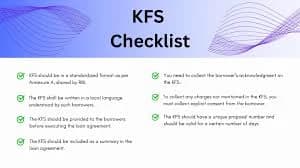
A digital lending app cannot bundle the KFS inside the final loan agreement file to make you sign both at once. They must show you the KFS first as an independent screen or document. You must read it, understand it, and provide an explicit digital signature or OTP verification before they are even allowed to generate the final loan contract.
The Mandatory Review Period
You do not have to rush your decision under pressure. For any loan that has a repayment period of seven days or longer, the RBI grants you a mandatory evaluation window of at least three working days. The loan offer and the processing fees listed in that KFS are locked in and cannot be altered by the lender during this review time.
Summary Checklist for Reviewing a KFS
Loan Component to Check | What to Look For | Red Flag Warning Signs |
Net Disbursal Amount | The actual cash deposited to your bank account | It is significantly lower than your approved loan limit |
Annual Percentage Rate (APR) | The true total cost including all fees | The APR is much higher than the stated flat interest rate |
Insurance / Add-ons | Check if loan insurance is optional or mandatory | A premium is added to your costs without your consent |
Contingent Charges | Clear definitions of late fees and bounces | Vague statements like "charges as per bank policy" |
How to Deal with Unlisted or Unfair Charges
If you review your statement and discover unreasonable fees, you have full authority to reject the offer. You can simply close the application screen during the three-day evaluation window, and the lender cannot charge you a single rupee for walking away.
If a lender attempts to collect a fee later during your repayment cycle that was never mentioned in the original KFS, do not pay it. Take a screenshot of your original KFS document and submit an official complaint to the bank's internal grievance cell.
If they do not resolve your issue or fail to give you a satisfactory answer within 30 days, you can escalate the matter directly to the RBI Ombudsman online. The central bank takes KFS violations very seriously and can penalize financial institutions that ignore these transparency rules.
Conclusion
Learning how to check key facts statement kfs for hidden processing fees is an essential skill for managing your personal finances safely. The KFS is a powerful tool designed to give you complete visibility into your debts, ensuring that no lender can exploit you through confusing fine print.
Always make it a strict rule to check the net disbursal amount, inspect the itemized charges table, and look at the total APR before giving your final consent. By staying alert and using your consumer rights under RBI guidelines, you can keep your borrowing journeys clean, highly affordable, and completely free of stressful financial surprises.
Frequently Asked Questions (FAQs)
1. Is a Key Fact Statement mandatory for credit cards too?
No, the standard Key Fact Statement rules do not apply to credit card products. Credit cards are governed under a separate master framework by the RBI, which requires lenders to provide a "Most Important Terms and Conditions" (MITC) sheet instead of a traditional KFS layout.
2. Can a lender change the processing fee after I sign the KFS?
No, the terms listed inside a signed KFS are legally binding. A lender is strictly prohibited from altering the interest rate, increasing the processing fees, or adding new charges during the loan cycle unless they get your fresh, explicit consent through a new document.
3. What should I do if a digital loan app does not show me a KFS?
If a digital loan app attempts to push you directly to a final loan agreement screen without displaying a proper KFS, stop the process immediately. This is a massive red flag indicating an unauthorized or non-compliant lender. You should avoid borrowing from such platforms.
4. Why is the processing fee non-refundable if I cancel my loan?
Processing fees are charged to cover the immediate administrative costs of running your credit check, verifying your identity documents, and setting up the loan files. Because these operational steps are completed upfront during underwriting, the fee is generally non-refundable.
5. Does the KFS show the penalty charges for missing an EMI?
Yes, a compliant KFS must clearly declare all late payment penalties, EMI bounce charges, and penal interest rates. Furthermore, these penalties must be stated as a flat physical fee or a clear percentage, as lenders are banned from charging compounding interest on penalties.
6. Can I get a copy of my Key Fact Statement in my local language?
Yes, under recent RBI updates, lenders must provide the KFS in a regional language that the borrower fully understands. If the app or bank only provides an English version and you are uncomfortable with it, you have the right to request a translated version before signing.